Recently I was invited to give a poetry workshop on a reflection day at a local school. They wanted the writing element of the day to help students understand themselves better, so I chose to provide a workshop based on George Ella Lyon’s poem, “Where I’m From.” You know I love that workshop.
Together, we looked at how details bring poetry to life, brainstormed images about their childhood experiences, explored how various creators have interpreted the “I am From” prompt to create videos, paintings, photo essays, poems, and combinations thereof. Then I invited them to work multimodaly as they knit together their images with color and imagery.
But I had never worked with them before, and none of them had heard of multimodal communication, though they’re surrounded with it everyday. I realized I had left out a crucial step in the workshop, to help them see that multimodal communication would go well beyond “decorating” their poem or underlining all the lines in color.
So how can we introduce this concept to students? How can we help them see that text, images, audio, and video can all convey such very different shades of meaning in communication? This week on the pod, let’s talk about introducing multimodality, and showing kids what works and what doesn’t. Be sure to grab the free download that goes along with this episode, a slideshow full of examples you can share with your students.
You can sign up to have me send it over totally free right here. You’ll also be subscribed to my teaching idea emails, though of course you can unsubscribe at any time.
OK, let’s dive in.
Start by Exploring Modes
As I thought about how to help kids see how you can communicate about one thing in many different ways, I wanted to choose a simple example to begin.
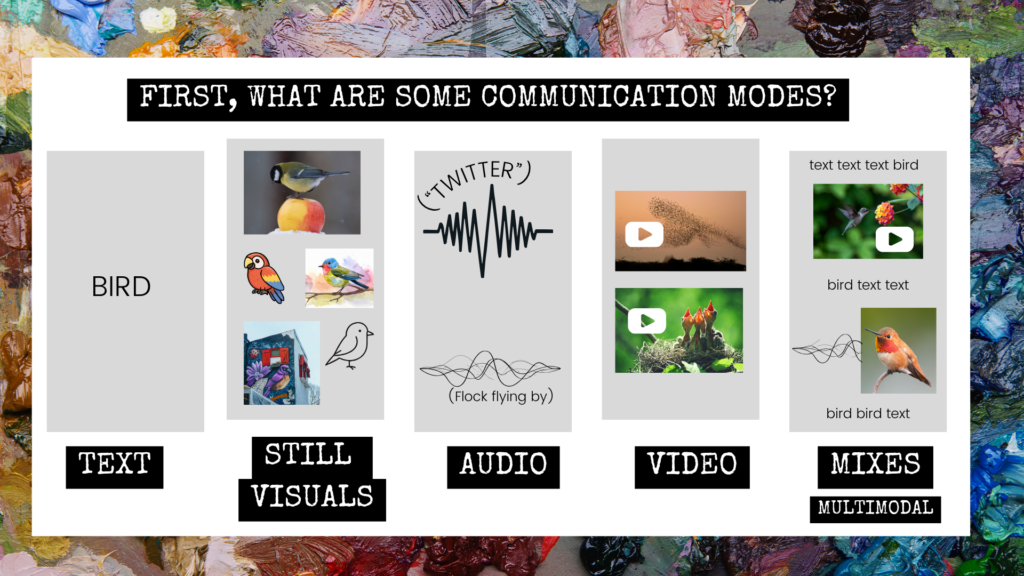
For example, in sharing about a bird, what could different modes offer?
Students might share a written image of a bird and express a lot. But how might a painting, mural, photograph, or cartoon of a bird add a dimension? How could audio add another way to understand birds? What could be expressed with a short video that would create another layer? How might the bird live for the audience through combinations across these modes? I made a simple slide to show these varied ways to communicate the idea of a bird.
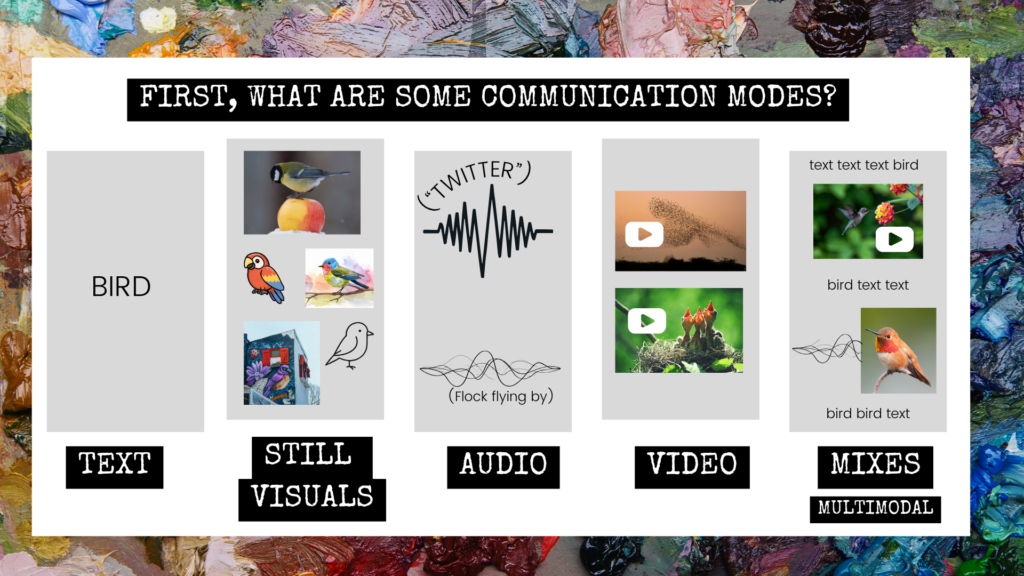
So that’s a foundation to build on. But still, I bet you can think of a lot of examples of student work where the real communication was all happening in one mode while the others simply provided vague additional representations of the same idea without adding anything.
So next, I wanted to show students some models. What might a piece of text convey alone? What if basic images were added that didn’t really create any additional layers of meaning, what might that look like? But what if additional modes were layered on that DID add meaning, what might that look like? I created slides to show these contrasts for several different examples of multimodal projects.
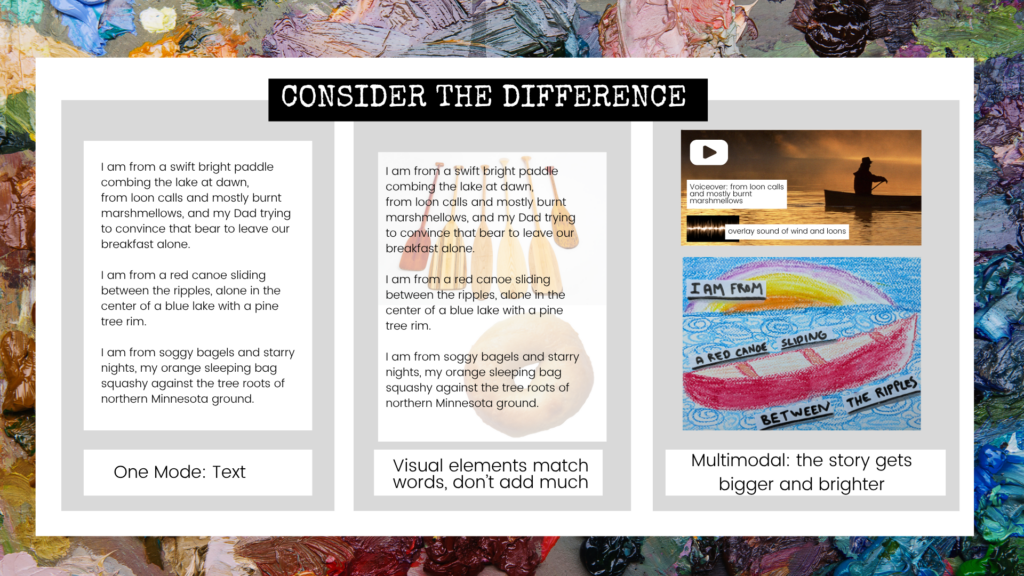
Consider this example (below) of the “I am From” poem. On the left, the text paints a picture of memories at the lake. It works as a poem with nothing else. Then, in the middle, I blended in some very basic illustrations of words from the text. Since the beginning talked about paddling I searched “paddle” and added an image from the search. Since the second part mentioned bagels I searched “bagel” and added an image. This is a level of (lack of) complexity that our students would often turn to if not pushed to go further. We need to explain that this doesn’t really add much. Sure, I can now see a canoe paddle and a bagel, but really, I could picture a canoe paddle and a bagel just from reading the text. I don’t feel any closer to the experience of canoeing and camping in the Boundary Waters because of these elements. If anything, they feel kind of distracting from the text. Contrast this with the multimodal model on the right. The idea here is that a video plays of a person canoeing across a silver lake at dawn, as mist rises off the water. There is voiceover of the text of the poem, with a soft underlying audio element of wind on water and loons calling. Would this, you might ask your students, bring you closer to the poem? Below the video example is an example of a piece of the poem overlaid on an oil pastel drawing of a canoe sliding through a lake at sunset. While this is not particularly impressive art, it shows my memories of the canoe I actually sat in as a child. It’s personal, not just a generic image of a canoe that I searched up or had AI create for me. In that way, it brings the viewer closer to my memories. It communicates my experience, as an additional layer to the text.
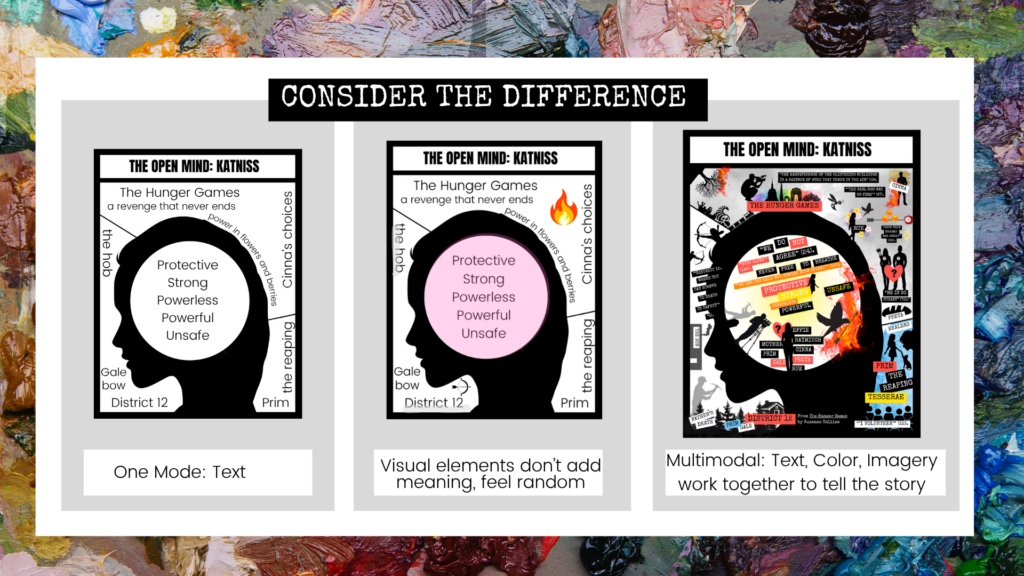
Next, I created a set of contrasting interpretations of the “Open Mind” project for characterization, a favorite project of mind that pushes students to use multimodal elements together to convey ideas. On the left you can see a very basic text-only open mind for Katniss. After looking at this, you can see some of what Katniss is like, and some of the external forces that affect who she is and how she acts. In the middle, you can see weak multimodal layers. In this version, a color is used but not with any apparent meaning, and several images are woven in that don’t really interpret or add layers to the original ideas. Contrast this to the multimodal exploration of Katniss on the right, where imagery, color and text weave together to interpret Katniss’s experiences, relationships, environment, and motivations. Each layer is intentional, working together to tell her story.
I could show you more slides, but I’ll let you discover them in the slideshow. Let’s just finish with one more, a piece of digital blackout poetry. Here again we can see a text version on the left. It’s a solid little poem, pulled from a blackout of a page of Fitzgerald’s text. In the middle, we see a theoretically multimodal piece, where imagery is added at the very surface. Several words are highlighted in green, reflecting “his green dream” as a line of text. A photo of a gate sits next to the words “empty gate” and a photo of a house sits next to “shadowy house.” And it’s shadowy. But is that enough? Negatory. In the third image, it’s clear that the different modes each contribute their own layer of meaning. Imagery surrounds the text poem which helps to interpret its underlying meaning, and includes colors that match key themes from the work the text is pulled from. The imagery and color choices bring up additional ideas, layers beyond the text.
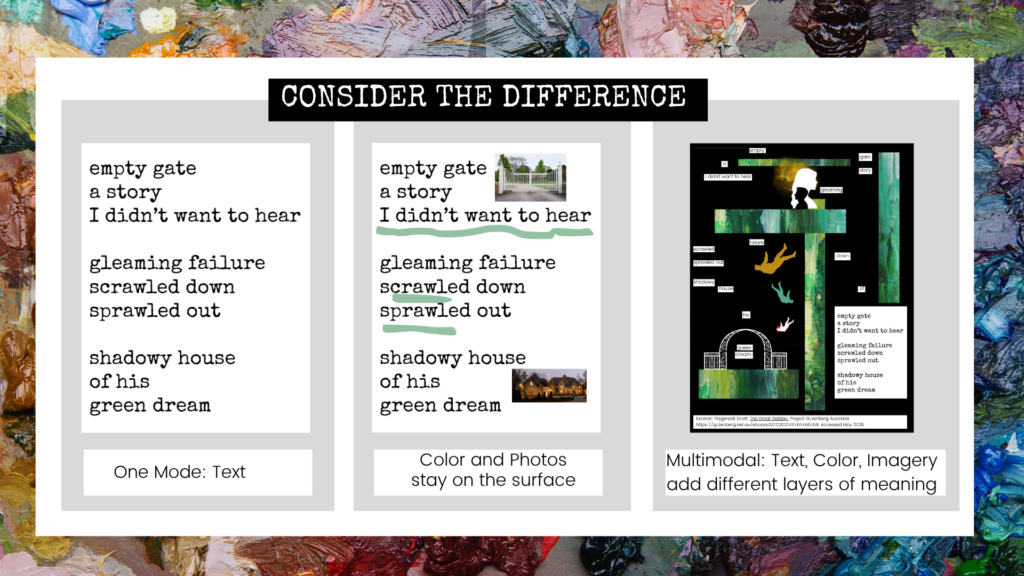
In creating this slideshow, the key takeaway I wanted to create for students was that each mode can contribute something unique to a piece of communication, but only if each one is treated with respect, not simply as a quick illustration for text. This is essential as they work across modes. If an audio component is simply reading a bit of written text aloud, and a visual component is simply a Google Search for the word from the text they want to convey, they are not using multimodal communication in all its rich potential.
Once you explore these models with students, you could go further and explore professional multimodal work, like this incredible multimodal piece at The New York Times, Avalanche at Snow Creek, that I first learned about in the book, Creating Confident Writers. In small groups, students might choose elements from the piece and consider what they bring to the meaning table, so to speak. Why that video? Why that link to that photo carousel? Why that weather map? What does it all add? Invite them to consider whether the multimodal elements added to their understanding of and interest in the piece. I will be shocked if they didn’t.
Sources:
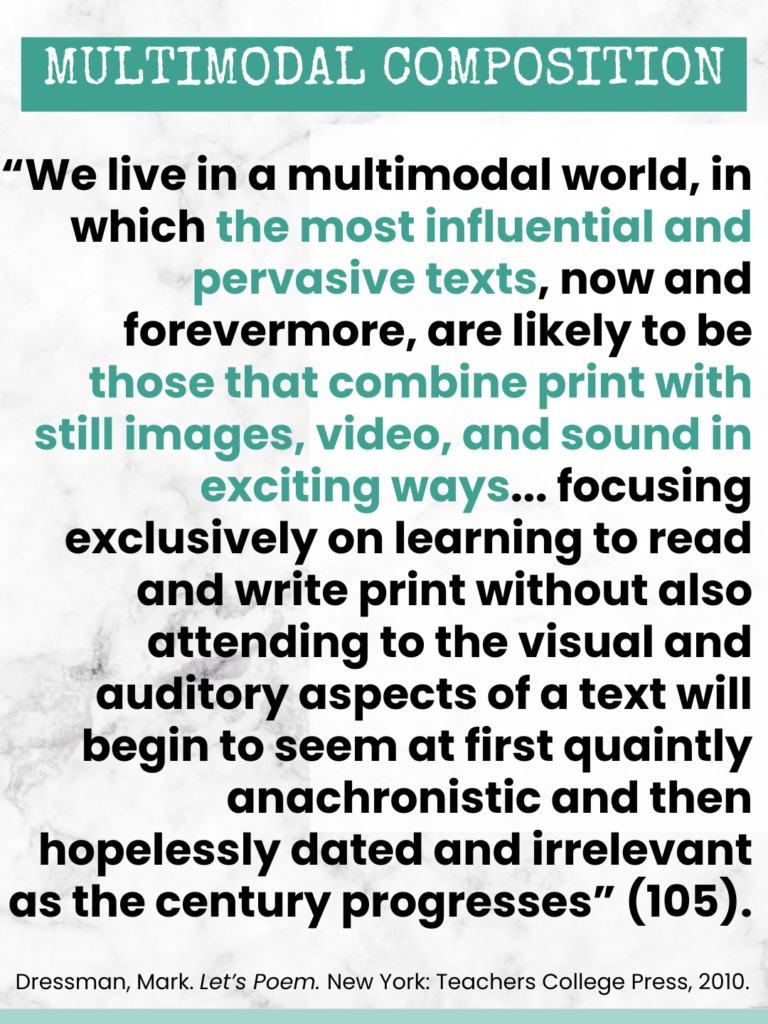
Dressman, Mark. Let’s Poem. New York: Teachers College Press, 2010.
Karchmer-Klein, Rachel. “Writing with Digital Tools.” (chapter 8) Best Practices in Writing Instruction. Ed. by Steve Graham, Charles MacArthur , and Michael Hebert. New York: Guilford Press, 2017.