Design thinking is a framework for creating things. And creating things, as Semour Papert argued in his theory of constructionism, is the kind of “hard fun” that engages people in meaningful work that helps them stretch themselves (Resnick). As his colleague at the MIT media lab, Mitchell Resnick, put it: “they’re going to learn fast when they work on things they really care about. Seymour once said that education has very little to do with explanation, it has to do with engagement, falling in love with ideas.” Design thinking is one of the many options in your teacher toolbox, but it’s a good one, so let’s dive into what it is and what it means.
What is Design Thinking?
I first became familiar with design thinking when I read Dr. John Spencer’s book, Empower, and interviewed him on the podcast years ago. He had his own twist on design thinking for education, which he called the launch cycle.
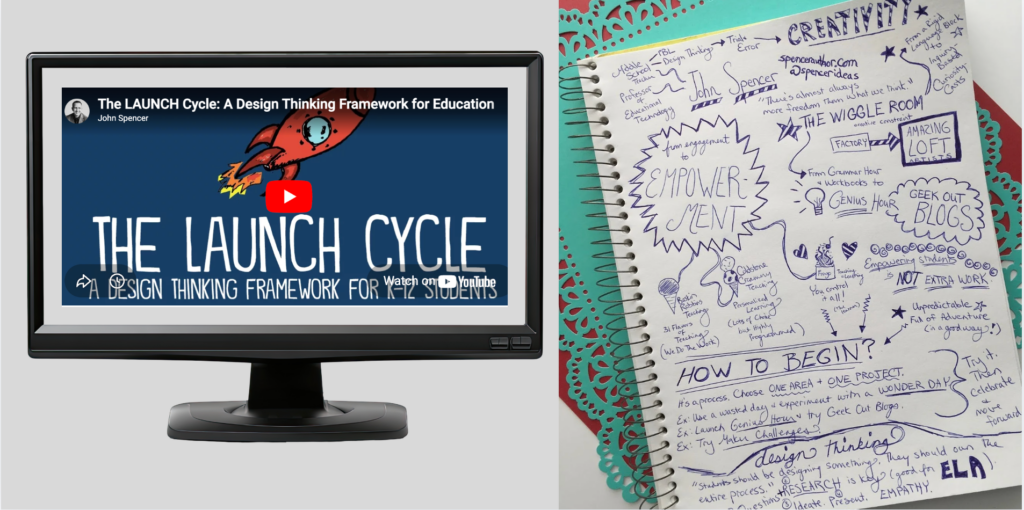
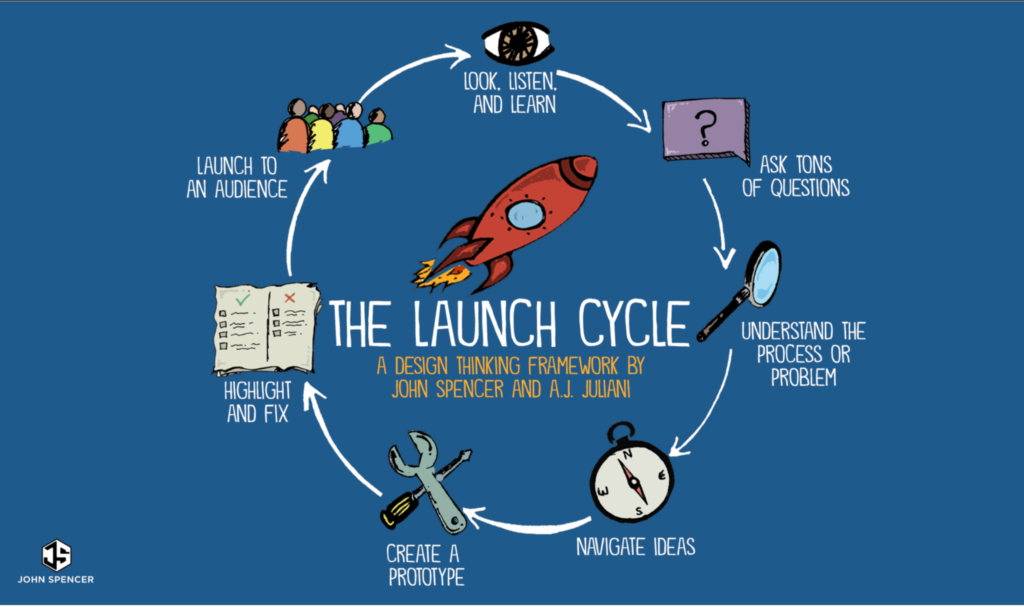
Launch Cycle Graphics by John Spencer. Sketchnotes from our interview by Betsy Potash
Perhaps the most popular model for design thinking comes out of the Stanford design school, and it’s similar but a bit simpler. You can see many similarities between the two.
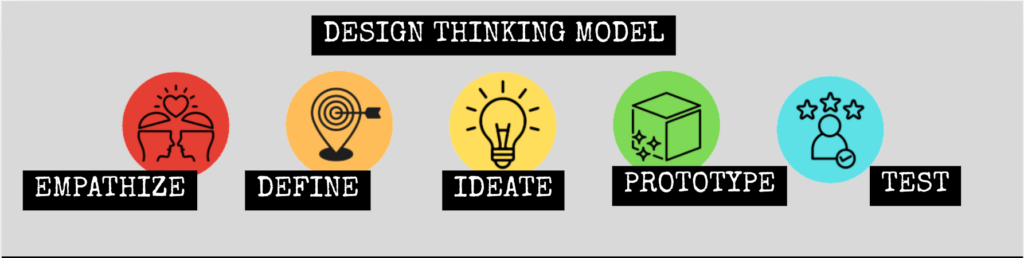
My Graphic Based on The Stanford d.School design thinking model
In both versions, designers (in our case, students) are asked to learn about the context for their problem and understand the people they want to help, then brainstorm possibilities, choose an idea, prototype it and improve it.
I like that John includes “Launch” as his final phase, rather than stopping at “Test.” “Launch,” to me, is a more satisfying final step in a design cycle than “Test,” and I think the same is going to be true for students.
Implications of Design Thinking for ELA
So what’s the deal with this “design thinking” model? Why think about it or use it in ELA class?
Whether you choose the Stanford design thinking bootleg or John Spencer and A.J. Juliani’s’s launch sequence, design thinking is a useful frame in helping students approach problems with creativity and thoroughness. By following the steps, they’ll need to think deeply about their problem and its context, the people they want to help, the possibilities involved, and their best options for solving it. They’ll have to use a growth mindset as they test out their prototype and then improve it. They’ll have agency in the process, an engaging chance to tap their creativity in coming up with a useful innovation to help solve some real problem they see in the world.
You can use the design thinking model for almost any project, but let’s look at a couple of examples.
Zoom: Design Thinking in Class
I’m planning to use it next year as I launch an app design project with my ninth grade class in the fall. While reading The Outsiders, students will be designing apps to somehow help break down our polarized digital bubbles online. The design thinking model will be perfect to help guide them as designers.
It could also be a wonderful frame for a PBL unit. Cathleen Beachboard, our previous guest in episode 81, had her students tackle a set of community problems that she gathered from local business owners.
Iowa Big, an innovative program in Cedar Rapids, Iowa, whose co-founder Trace Pickering joined me on the podcast as well, also guides students in tackling two community projects each semester.
If you’re interested in something similar, whether through a PBL unit or a genius hour project, students can approach any problem in the community with a design thinking process.
Zoom: Design Thinking for Teacher Use
And what about you, as the teacher? Yep, you can use it too! Likely, you already are. Imagine that you want to start a new choice reading program (here’s help, by the way).
You might start with empathy, trying to figure out what’s going on in your students’ reading lives. You might ask them about when they read, how they read, what they read, why they don’t read, what kinds of reading frames at school they liked in the past.
You might brainstorm ideas for your program based on what you learn, adding ideas from your research and exploration online that seem to fit what your students want and need.
You might make decisions about the program and start to build it out, but keep it a bit loose in your mind. As you start to proceed with the program (your prototype), you notice a lot of things. That ten minutes works better than fifteen for quiet reading at first. That your students seem to be obsessed with fantasy. That three of your students can’t sit still to read right now and might be better off listening to audiobooks and drawing.
Out of this testing, you improve your program prototype.
You adjust the length of the reading time, get more fantasy books, build a fantasy display, give a book talk on your favorite fantasy book, and open up an audiobook counter option during reading time.
At this point, you are free to loop back into any phase of the designing process at any time.
You can be continuously designing and redesigning your program, adding new elements, responding to student needs, paring back things that aren’t working. You are an education designer, using the design thinking model to create the best possible experience for your students. Something not working is just evidence that you’re ready to tweak the prototype and move it forward, certainly not that you have failed in creating a choice reading program. The designer’s mindset turns everything into a prototype in test mode, always ready for the next step forward.
I bet, as you listened today, you realized you already use a lot of design thinking in your work, and that you’ve already encouraged this kind of thinking in your students, perhaps without this name.
There’s something nice about going formal with it though, and naming design thinking in your classroom. When students see themselves as designers, they step into a context of empathy, creativity, and growth mindset that can help them do the meaningful, engaging work that fits Seymour Papert’s concept of “hard fun.”
Sources:
“Design Thinking Bootleg.” Stanford d. School: https://dschool.stanford.edu/tools/design-thinking-bootleg. Accessed April 2026.
“Mitchell Resnick on Seymour Papert.” Youtube: https://www.youtube.com/watch?v=ZoczAscGYeQ. Accessed March 13, 2026.
Potash, Betsy. “Empower your Students, with John Spencer.” The Spark Creativity Teacher Podcast, Episode 28.
“The Launch Cycle: A K-12 Design Thinking Framework.” Spencer Education: https://spencereducation.com/the-launch-cycle/ Accessed Apr. 13, 2026.