A summer reading lesson is a nice chance to start off the year with a creative tone, while creating some of the norms you want to establish. For today’s “Plan my Lesson” series episode, I’m answering requests from two different teachers in search of a back-to-school lesson on summer reading. One teacher’s class will have read Scythe, another’s The Hunger Games. Both are interested in reviewing the basics of literature as a springboard into the year.
So how can we capture students’ interest, review some key basics, like symbol, theme, and the hero’s journey, give students a chance to show their understanding of the text, and establish a positive, creative tone for the year in a class period?
Let’s give it a shot together. One of my teacher requesters today is teaching on a block schedule, so we’re going to go ahead and plan a longer period. If you’re NOT teaching on a block schedule, feel free to split this plan over two class periods.
Agenda
As per usual, I suggest you project your agenda on the board or write it up there, with an approximate time window for each part of class. Cut down on questions before they start, and help students stay on track in terms of their timing with this simple scaffold.

For your attendance question today, you might consider something lighthearted related to the summer reading, like “Team Peeta” or “Team Gale” for The Hunger Games.
Introducing the Project
Once your students are settled in their seats, let them know they’re going to be choosing a character from the book and working on a project called “The Open Mind” for that character in class.
At this point, you might show some examples of an open mind like the ones down below.


You might even give out your requirements at this point and give them a little time to look (but not start).
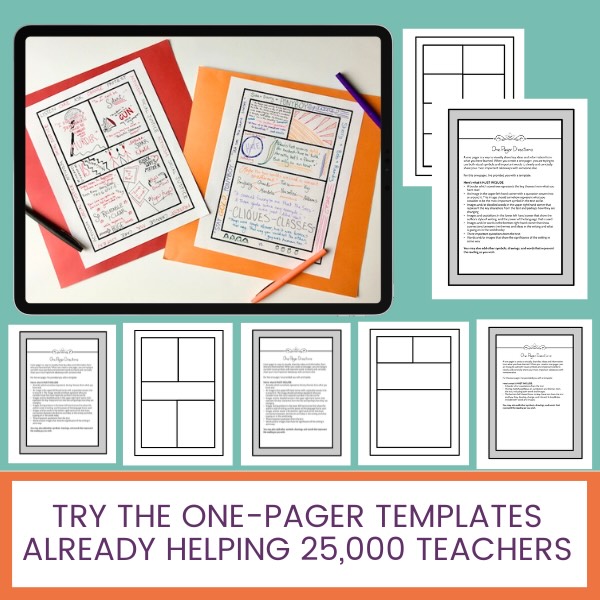
If you’re new to the open mind project, the idea is that students will showcase what’s going on for a main character. Inside the character’s head, they will use adjectives, quotations, descriptors, and imagery to show who the character is, what they want, how they change, etc. Outside the character’s head, they will divide the paper into several sections and showcase key relationships, events, or settings in the characters life. Overall, they should try to use size, color, and location of their key elements intentionally, to help show their analysis visually as well as through the text.

Now, in this case, because you want to review certain key aspects of literature through the project, I would incorporate that into the requirements. Ask students to include at least one symbol, theme, etc. (whatever it is you wish to review) and define those on the assignment sheet for handy reference. Then, before you start, take time to briefly review those key ideas. Now students have a clear reason to pay attention to your review, since they’ll be using the ideas you share in their projects.
Quick Concept Review: Theme, Symbol, etc.
Now it’s time to do this review. This could be a slideshow, a quick infographic you pass out for them to keep as reference, a short video, etc.


Project Work
Now it’s time to give THEM time to work on their projects. They can work in Canva if you’d like to introduce that platform at the start of the year, in Slides, or by hand with art materials you provide. If you wish, you can let them work together with someone who chooses the same character as them, or everyone can work on their own. This will be the main part of the period, possibly extending into homework time and the next day.

Museum Gallery Scavenger Hunt
Once your students complete their open minds, let them know you’re going to create a museum gallery of the characters. Ask each student to create a one-paragraph caption for their open mind, explaining their choices and what key aspects of their character they were especially trying to get across with their visual and textual choices. Have everyone put their work up on the wall, with the open minds above and the captions just below.
Now pass out a scavenger hunt sheet. Whatever it is you were trying to review (symbol, theme, etc.), invite students to search out examples in each other’s work. This scavenger hunt sheet will be their exit ticket, showing you where they might still have gaps in understanding and where they understand the concepts you’ve just reviewed.
Teaching Takeaways
One teaching takeaway I’d like to focus on here is the idea of purpose. When you introduce a project and let students know they’re going to need to understand something to be successful with it (in this case symbol and theme), you give them a reason to pay attention as you review those terms. I find this especially helpful when launching into big projects like a poetry slam, where students suddenly become a lot more interested in the craft moves that make a good poetry performance because they know they will soon be delivering a performance of their own. Same for play performances, essay competitions, and other projects with real-world audiences.
Another is the way the open mind project invites students to showcase ideas through a combination of words and visuals. If you’re a regular listener, you know this is a big thing for me – I believe information today is so often communicated through multiple mediums, and it’s important for students to have practice with that. It’s possible to convey a lot about characters through visual imagery and colors as well as quotations and descriptors, but it does take practice, and it’s important that students understand the point isn’t that they have to be, for example, incredible at drawing a shaded picture of a mockingjay, but rather that they consider how to communicate ideas across mediums. Sometimes that may be text and audio, sometimes it may be video and voiceover, sometimes it may be text and visuals, but the point is, communication today is often about words plus.