You know how some spaces just make you feel excited to DO something? Whether it’s a Cricut getting your wheels spinning with what-ifs, beautiful shelves of paint inviting you to decorate holiday pottery, or a giant stack of cookbooks suddenly causing you to wonder if it’s time to fill the cookie jar, well-organized resources in a creative space can help bring out your creative side.
Today, let’s talk about how to choose and organize flexible resources for your ELA classroom, anytime you’ve got the budget and bandwidth. (Check out this post on how to use Donors Choose, if your budget is continuously falling short of your needs).
Ooh, one more thing before we start. Throughout this podcast, I’m showcasing graphics and displays from the #evolvingEDdesign Toolkit, a vast free resource I made for you. You can grab it here.

We’ve already discussed flexible seating and flexible displays in the series, so now we’re diving into the movable resources in your classroom. Let’s consider five possibilities today: your library, your maker materials, your resource decks and posters, your media elements, and your idea-holders.

Building your Library
If you don’t have a classroom library yet, now is the perfect time to start! No library is too small, it is simply a beginning. Search out a windowsill, a single shelf, or a bookshelf on the curb in your neighborhood, and start placing books, covers out. Start with the absolute most popular books with your students – better to have 10 pass-them-around-as-fast-as-you-can winners than ten boxes of books people donated from their basement because no one wanted to read them.
Having even a small curated library in your classroom is a great example of how a flexible resource can pay off in your lesson design. Did Kae finish early? Maybe Rian needs a few minutes alone because they had a rough personal experience at lunch? Are you doing a reading sprint but Joe forgot to bring his book? Your books are there, ready to step in and fill the hole.
Below, you’ll see a few of my favorite books for high school and middle school libraries, though of course you’ll need to use your own judgment for what is a good fit for your community.

Art & Maker Materials
Early in my classroom career, I realized I wanted a huge marker collection and a range of costumes for many of my lessons. I went to my department chair to share how often I was inviting students to create and design in color, and she quickly agreed to fund some art supplies. Later she forwarded me an application for a community grant, and I was able to get $100 for a costume corner.
You know best what types of art and maker materials would be helpful in your classroom. But here are some ideas…
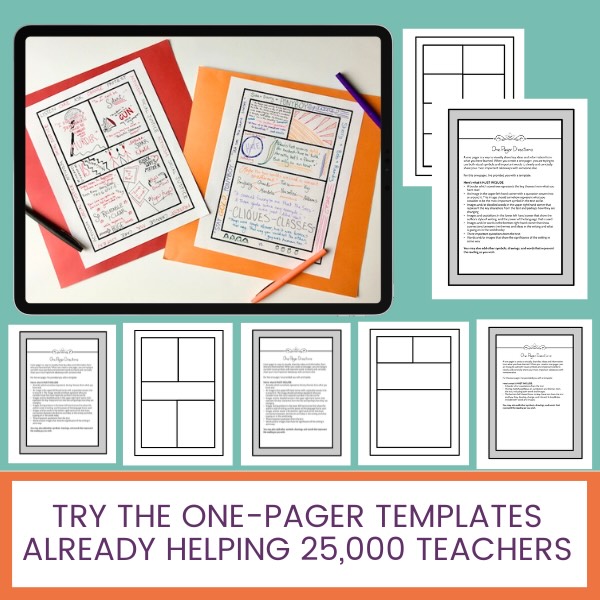
Art supplies: colored pencils, markers (that don’t run out too fast), and crayons are flexible resources students can use when they sketchnote, design one-pagers, make 6 word memoir posters, storyboard scenes from novels, prototype theater masks, illustrate children’s books, etc.
Maker materials: As Angela Stockman – writing makerspace pioneer – has shared with us on the pod in the past, you don’t need a ton of expensive materials to help students #makewriting. They can lay out ideas on notecards or post-its, shape characters out of play-doh or popsicle sticks, build arguments out of recycled materials. If you’re feeling excited about all this and want to go further, check out this post: How to Start a Writing Makerspace.
Resource Decks and Posters
Is there something your students tend to struggle with, year after year? Maybe it’s remembering MLA format, keeping track of the difference between similes and metaphors, or understanding how to ANALYZE the quotation they’ve just dropped into a paragraph before moving on. What physical scaffolds could you keep in your classroom to help? Maybe it’s a poster series with the most common uses of MLA, a set of literary terms vocabulary cards, or a set of models from past student papers of beautifully analyzed quotations highlighted in bright orange. These collections can be labeled and clearly available for students to use at any time.
Resource decks and posters can also be for you! Maybe you want to keep a deck of lesson ideas handy like the Ed Deck (or your own version).

Or maybe you want a poster of attendance question ideas near your desk…

Media Elements
Next up, multimedia options! While you can absolutely experiment with multimedia projects without investing in classroom tech (Vocaroo works great for recording audio and it’s free on Chrome, for example), if you’re able to build a small collection of media elements as project assets, that’s helpful. Consider options like a microphone, green screen, or noise-canceling headphones.
Idea-Holders
This is a fun one, and one we maybe could think about more. Post-its, giant post-its, butcher paper, foam board, white boards, chalkboards, bulletin boards – glass windows + expo markers… idea-holders can be a powerful partner for students trying to come up with ideas, showcase ideas to each other, prototype and improve ideas, collect evidence, etc. Investing in or creating different sorts of idea holders around your room is a great way to empower student creativity.
Last but not Least: Add Signs
Last but not least, as you’re organizing resource collections in your classroom, whether it’s a theater corner, a set of colored pencils, or a box of post-its, think about how you can make the space student-run. Signs help a lot, making it clear what’s available to use and how to take care of. I’ve included a range of signs in your free toolkit, or you can make your own. Talk to your students about what you’re making available, why, and why it’s important to work together as a group to take care of the resources. I have repeatedly found students to be receptive to checking out and bringing back classroom library books, returning costumes to the costume corner, cleaning up their markers and putting them back in the bin, etc. as long as the expectations were clear. Sure, I helped, but it wasn’t all on me, and I don’t want it to be all on you either. Signs can help reinforce your expectations for good care at the same time they empower students to feel it is their space to use.


Don’t Forget to Grab the Toolkit
Ok, my friend, today we focused on flexible classroom resources, and I’m sure you’ve got many more ideas than what we’ve covered in this episode! This is the last in our classroom design series for now. Don’t forget to grab your copy of the #evolvingEDdesign toolkit for everything we’ve talked about and please do share your takeaways, ideas, expertise, and experiments online under the same hashtag.

If you’re looking for more inspiration today, check out the “11 pm on Amazon” page of your toolkit, which will give you links to all kinds of fun flexible resources possibilities for your classroom the next time you have budget, a grant, or a parent wanting to know “what would be helpful?”

Sources Considered, Consulted, and Cited for this Series & for the Toolkit:
Abdaal, Ali. Feel Good Productivity. Celadon Books, 2023.
“Aesthetics and Academic Spaces.” Teachers College, Columbia University Youtube Channel: Curriculum Encounters Podcast, Episode 4. https://www.youtube.com/playlist?list=PLuFs4Fyk-v0Bwtuy1eQJ3JkRTeL4Sjyz4 Accessed Oct. 21, 2025.
Chavez, Felicia. The Anti-Racist Writing Workshop. Haymarket Books, 2021.
Dintersmith, Ted. Documentary: Most Likely to Succeed. 2015.
Dintersmith, Ted. What Schools Could Be. Princeton University Press, 2018.
Doorley, Scott & Witthoft, Doorley. make space: How to Set the Stage for Creative Collaboration. John Wiley and Sons, 2012.
“Exploring Google’s Headquarters in San Francisco.” Digiprith Youtube Channel: https://www.youtube.com/watch?v=WxGqbmFf9Qc. Accessed October 13, 2015.
“High Tech High Virtual Tour.” High Tech High Unboxed Youtube Channel: https://www.youtube.com/watch?v=87xU9smFrj0 . Accessed October 15, 2025.
“Inside YouTube’s Biggest Office In America | Google’s YouTube Headquarters Office Tour.” The Roaming Jola Youtube Channel. https://www.youtube.com/watch?v=P26fDfFBx8I . Accessed October 14, 2025.
Novak, Katie. Universal Design for Learning in English Language Arts. Cast Inc., 2023.
Potash, Betsy. “Research-Based Practices to Ignite Creativity, with Dr. Zorana Ivcevic Pringle.” The Spark Creativity Teacher Podcast, Episode 393.
Pringle, Zorana Ivcevic. The Creativity Choice. Public Affairs, 2025.
Ritchart, Ron and David Perkins. “Making Thinking Visible.” Educational Leadership, February 2008, p.p. 57-61. https://pz.harvard.edu/sites/default/files/makingthinkingvisibleEL.pdf. Accessed October 13, 2025.
Richardson, Carmen and Punya Mishra. “Scale: Support of Creativity in a Learning Environment,” 2017. Accessed through Drive with permission.
Richardson, Carmen and Punya Mishra. “Learning environments that support student creativity: Developing the SCALE.” Thinking Skills and Creativity, Volume 27, March 2018, p.p. 45-54. Accessed online at https://doi-org.proxy2.cl.msu.edu/10.1016/j.tsc.2017.11.004, October 13, 2025.
“Sensory Inquiry and Social Spaces.” Teachers College, Columbia University Youtube Channel: Curriculum Encounters Podcast, Episode 2. https://www.youtube.com/watch?v=DtD_-k5QmOQ&list=PLuFs4Fyk-v0Bwtuy1eQJ3JkRTeL4Sjyz4&index=2 Accessed Oct. 23, 2025.
Stockman, Angela. Make Writing: 5 Strategies that turn Writer’s Workshop into a Maker Space. Hack Learning Series, 2015.
Terada, Yuki. “Do Fidgets help Students Focus?” Edutopia Online: https://www.edutopia.org/article/do-fidgets-help-students-focus/. Accessed 4 November 2025.
Utley, Jeremy. “Masters of Creativity (Education Edition) #1: Input Obsession (Design Thinking).” Stanford d.School Youtube channel: https://www.youtube.com/watch?v=LosDd3Q0yQw . Accessed October 15, 2025.
Utley, Jeremy and Kathryn Segovia. “Masters of Creativity: Updating the Creative Operating System (Design Thinking).” Stanford d.School Youtube channel: https://www.youtube.com/watch?v=Ggza7df7N7Y&t=2233s. Accessed October 17, 2025.
“What is Curriculum and Where Might we Find It?” Teachers College, Columbia University Youtube Channel: Curriculum Encounters Podcast, Episode 4. https://www.youtube.com/watch?v=yh_UhGATVwM&list=PLuFs4Fyk-v0Bwtuy1eQJ3JkRTeL4Sjyz4&index=1 Accessed Oct. 23, 2025.