Earlier this month we started to explore creative poetry activity options for National Poetry Month (and any time!). But there were just too many to pack into one episode! I promised you a part II, so this week let’s continue our creative poetry fun together. If you’ve always felt a surge of irritation when you flip your planner to the next week and realize a poetry unit is on the horizon, I believe these two episodes can really help. Let’s dive right in.
Collage Favorite Lines into a new Multimodal Piece with this Poetry Activity
One way to help students explore contemporary poetry with an eye to finding what they like is to do a poetry collage. I like to start this activity by sharing Billy Collins’ Poetry 180 collection. Here, they’ll find a playground of 180 poems, curated by a poet laureate specifically to engage students. Pretty cool, eh?
Of course, you could do this with any curated collection or anthology.
The goal for students is to find lines they like, hopefully beginning to feel some connection to poetry as they choose from an enormous set of options which ones they connect to. You can ask them to write down four lines, six, ten, or however many you wish, making note of where those lines come from.
Next, after this period of exploration, it’s time for them to collage the striking lines together, adding imagery to help bind them. This can be done in Canva, on Slides, or on paper (assuming you’ve got magazines, glue, scissors, etc.).
Finally, you’ll want them to explain their thinking in writing. Why did they choose what they chose? Why did they connect it the way they did? Why did they choose the imagery and colors they chose to bind it all together? Alongside this writing, they should cite their sources, giving credit to the poets they liked and the photographers or artists whose imagery knitted them together.

Experiment with Poetry One-Pagers
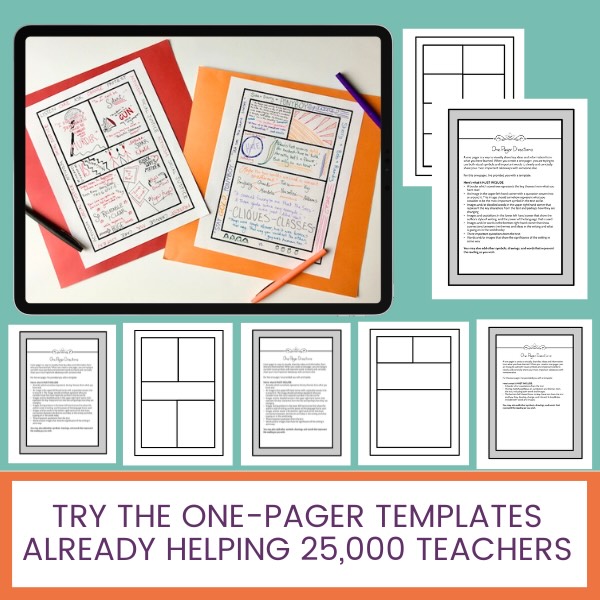
If you want students to read a poem deeply, a poetry one-pager makes a short and potent alternative to an essay. You can accomplish a lot of analysis, depending on what you ask students to put in their one-pager, and you can also push them to connect the poem to other works, to the world, to their lives.
Below, you can see my one-pager for “anyone lived in a pretty how town,” one of my favorite ee cummings poems ever since I had to memorize the whole thing and recite it in a college class at Pomona.
This particular template invites students to add imagery from the poem, explore craft moves in one corner, connections between the poem and another literary work or their own lives, key themes, style, and their own opinion about the poem. As with all my one-pager prompts, I suggest using a combination of imagery and text to help create meaning.


I am From Poems
There are many ways to form a poetry project around a wonderful piece of poetry. Students can write “I am from” poems modeled on George Ella Lyon’s “Where I’m From,” honest poems modeled on Rudy Francisco’s “My Honest Poem” (which I first encountered through Amanda Cardenas’ fabulous work), blues poems modeled on elements of the blues genre, as Mark Dressman writes about in his book, Let’s Poem.
One year a visiting writer came into my classroom to help students imitate Wallace Stevens’ “13 Ways of Looking at a Blackbird,” and great things happened. Turns out there are a LOT of things you can look at from 13 different angles, and it’s pretty fun to try out Stevens’ moves.
But one of my favorite go-tos remains the I am From poem workshop. It’s never failed me, and there are so many resources out there to add dimensions, like this crowdsourced collaborative version on NPR.


Lyon combines vivid, tangible memories from her childhood into lines that weave together in an easily imitable form: “I am from….X, I am from… Y, from Z and A,” etc. She recalls important people in her life, oft-heard sayings, vivid sensory memories.
Students can create their own poems, then pull pieces from them to contribute to a collaborative video, mural, or audio poem to represent the class as a whole. Or you can take it into the library or a local coffee shop and create a community collaboration, adding verses from the class but also leaving post-its or colorful cards along with prompts so that others can add their memories to the collage.
Collaborative Annotation
All too often, annotation becomes a marathon highlighting session or a post-it frenzy. Unsure of how to do it, kids find one go-to strategy and stick on it. A collaborative annotation project lets them learn from each other.
Here’s one way to do it, though you may want to create your own spin.
Print big versions of a poem (or of different poems) to tack up on your wall. You’ll need enough for student groups of 4 to each have one.
Inside their groups, students can divide up roles. Have each role work on something different. Maybe one person creates sketches and sketchnotes to help highlight meaning in the poem, another searches for literary devices and other craft moves and labels them. One person might find tricky words and define them, and track the rhyme scheme. You get the idea. Everyone can work on the poem at the same time, and they can help each other too. No need for the roles to be super strict. By the end of a work period of ten minutes or so, the poem posters should be starting to fill up. Students in different roles can then present back to each other.
Finally, consider a gallery walk around the room if everyone did the same poems, so each student gets to dive even deeper with the poem AND see even more interpretations of how to annotate, drawing process ideas for their own future annotations. If you did different poems, you might have each group present back for a few minutes, beginning with a read aloud of their poem.


Performance Poetry
I don’t think I say it enough, but the 20+ poetry slams I held in my classes were some of the most wonderful experiences of the classroom for me, and for my students too, I think. They combined so much of what is important for kids – contemporary texts that feel relevant, agency, authentic audience, creativity…
Every slam was completely different, because every slam was entirely defined by classroom committees in charge of judging, programs, and ambiance. Students invited guests and guest judges, chose locations all over campus, provided refreshments (custom-ordered burritos from a local favorite shop being the most memorable for me), acted as emcees, set up sound equipment, “lit” battery-operated candles, picked flowers, and everything else. I simply arrived and applauded, using a simple rubric and giving as much positive feedback for the emotional risk each student took to stand up in front of their peers as I possibly could.
I’d walk you through the whole unit, but I already did, right over here, so I’ll point you in that direction.

Looking for More? Check out Teach Living Poets
Want to go further? I’m going to point you toward my friend and colleague Melissa’s absolutely amazing website full of ideas for teaching more contemporary poets. Check out her incredible “Walk the Poem” activity, her “Shoe Design as Poetry Analysis” activity, her color analysis poetry activity, and so many more! Melissa has been a guest on the podcast, and collaborated with me as guest expert on poetry in The Lighthouse for several years, and I just love what she creates.