I’m not going to lie, the prospect of getting to set up a classroom space after years of dreaming about that very task is one of the reasons I’m headed back into the classroom this fall to teach one section of freshmen English. I just believe SO HARD that secondary spaces matter as much as elementary school ones.
Heck, I’m an adult, and the space around me matters enormously to my productivity and pleasure in work. How could it not matter to teenagers?
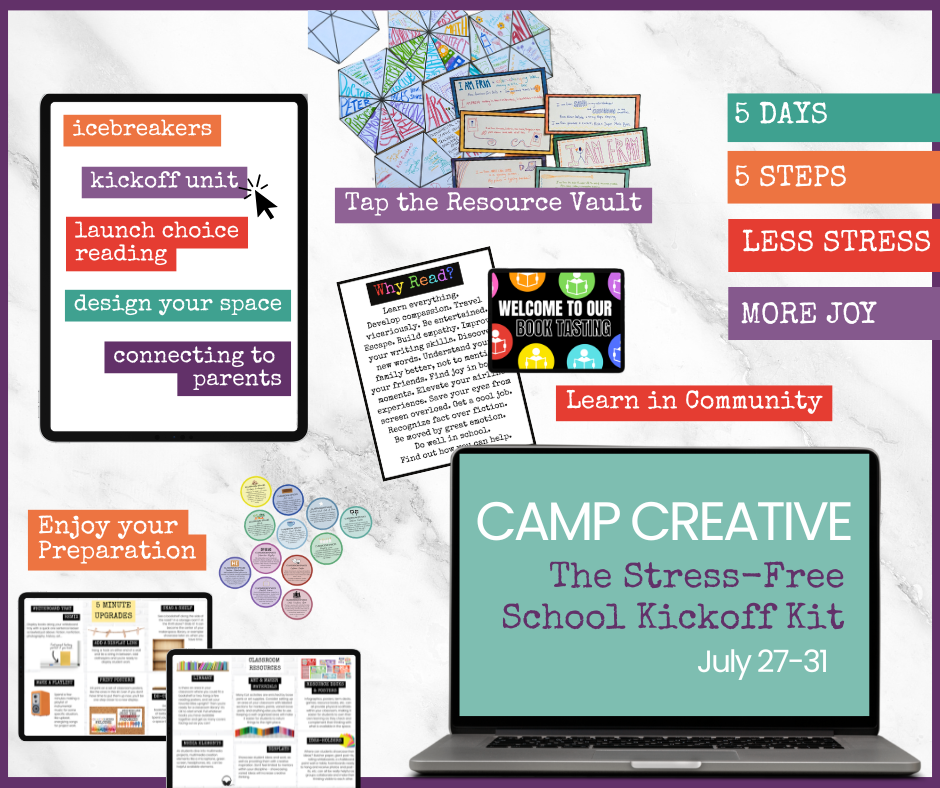
So today, I want to share a quick look at some of the resources and recommendations we’ll be diving into at the end of the month inside our free (asynchronous) PD, Camp Creative: Your Stress-Free School Kickoff Kit. We’ll keep it simple today, digging into five colorful, fun ideas for your walls. I’ll be sharing all the resources and links for these resources inside Camp, don’t worry!
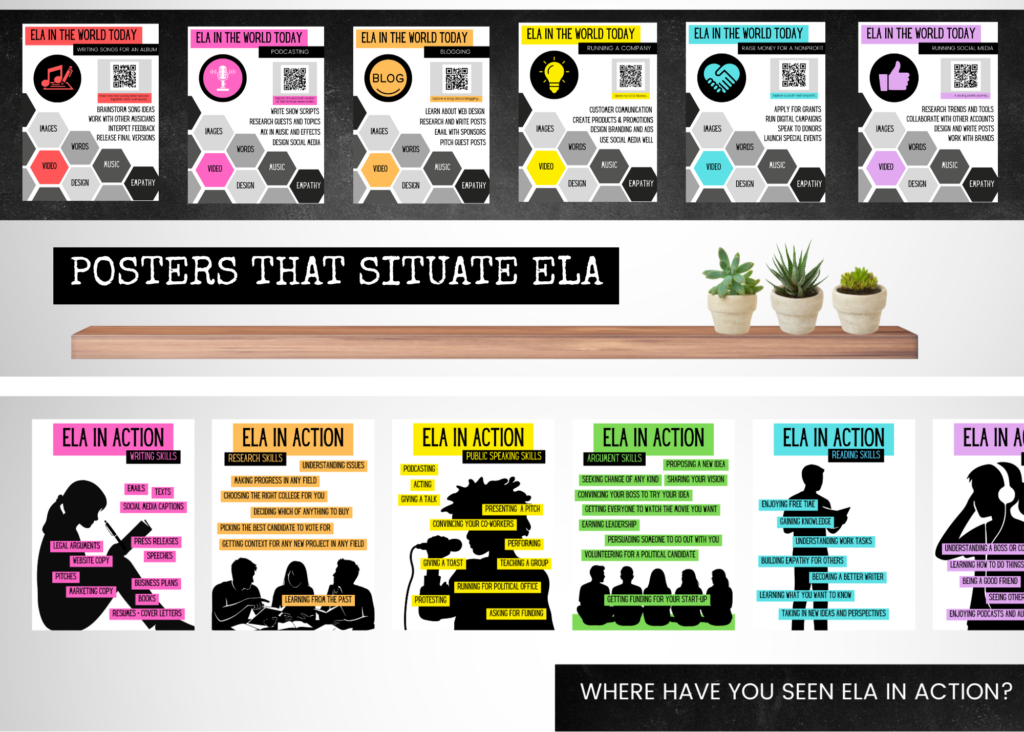
1: Posters that Situate ELA and Answer every Student’s “Why” Question
I can still remember the twisty frustration I felt inside while learning about imaginary numbers in 10th grade math.
“WHY?” I asked my teacher. “Why will imaginary numbers matter in my life? When will I use them? How will they help me?”
Yeah, that must have been annoying for her. I feel a little bad about it now.
But she didn’t have an answer that helped. “You’ll need it for math next year!” she told me. It did not inspire me to study with zeal.
Grant Wiggins and Jay McTighe help get at why knowing the answer to “why” matters so very much, in their book, Understanding by Design: “In neither case can students see and answer such questions as these: What’s the point? What’s the big idea here? What does this help us understand or be able to do? To what does this relate? Why should we learn this? Hence, the students try to engage and follow as best they can, hoping that meaning will emerge” (17). We don’t want to leave our students in this situation, “hoping that meaning will emerge.” Instead, we want to show them why ELA matters, tying their work to become better readers and writers to the MANY ways these skills will help them in their lives. These posters help build a foundation from day one.
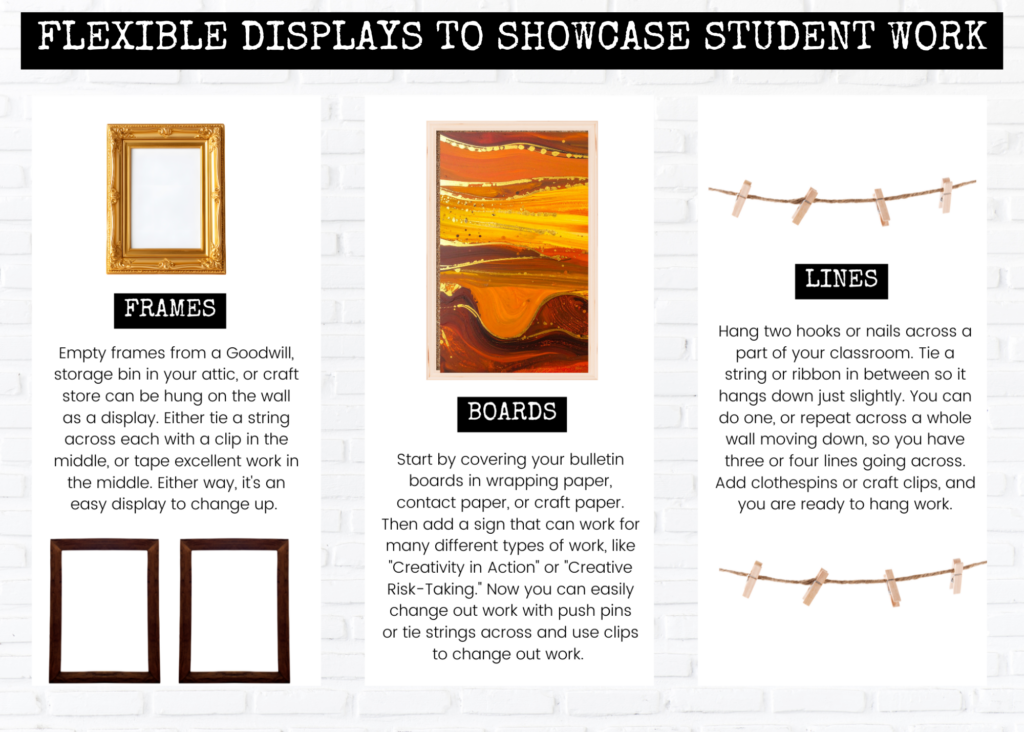
2: Flexible Displays to Showcase Student Work Quickly and Easily
In their work developing a tool (The SCALE) to help educators consider how to support creativity through their learning space design, Carmen Richardson and Punya Mishra came to the conclusion in their research analysis that showcasing student work throughout the space was one important component of creative learning spaces.
Does that mean you have to spend hours every week changing up student work and building out new displays?
NO.
Flexible displays, like empty frames with clothespins on them where you can clip in work in 1 second, bulletin boards already covered in a background paper with headers like “Creativity in Action,” Pernille Ripp’s fabulous idea “The Fridge,” or a fun nod to current slang like “Aura,” or clothesline-style display lines where you can add and take off work in minutes can make regularly featuring and rotating student work an easy part of your routine.
My friend and colleague, Lisa, recently told me her students loved to “make the frames” in her flexible frame display, and I bet yours will too!
3: PBS’ The Great Read Posters and Memes
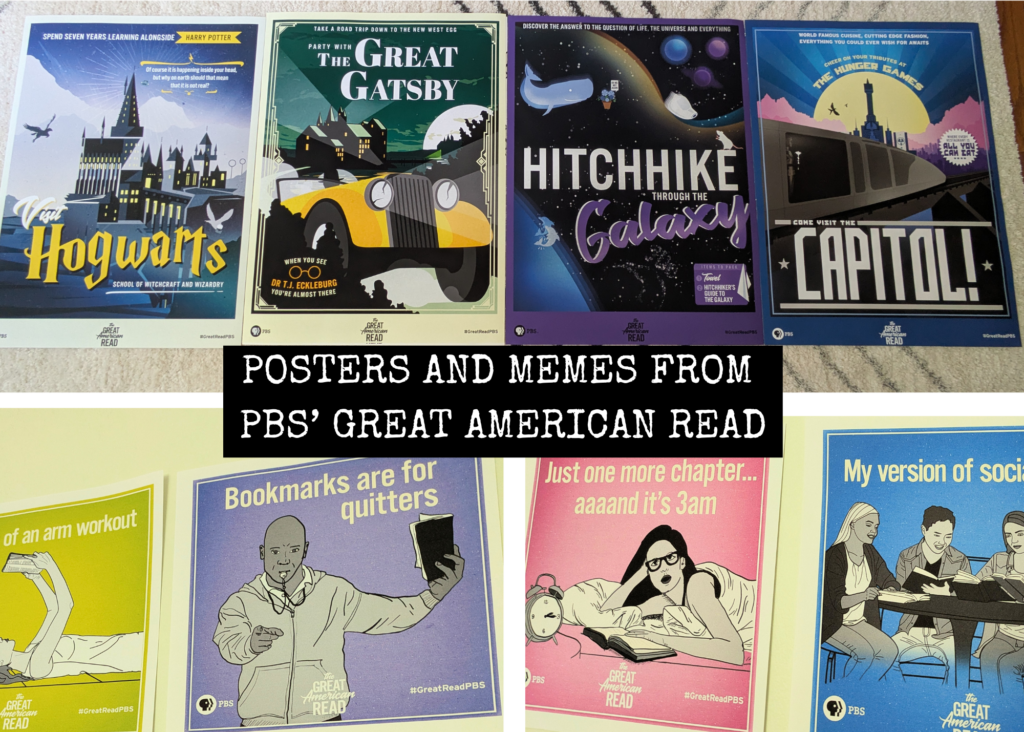
There’s not much to say here except hurry and go download these awesome resources from PBS! My new school was able to print beautiful high-resolution posters for me with a grant they have from the state that is partially earmarked for printing posters, but you could also try Canva, Staples, or another print shop. Or just pull the image files onto a doc and make them whatever size you can print on your school printer.
The novel-themed giant travel posters are stunning, but don’t forget about the memes. I’ve already seen one of my future students laughing at the “Bookmarks are for quitters” one I printed and saying “that’s totally me.”
4: Customize a Reading Bulletin Board
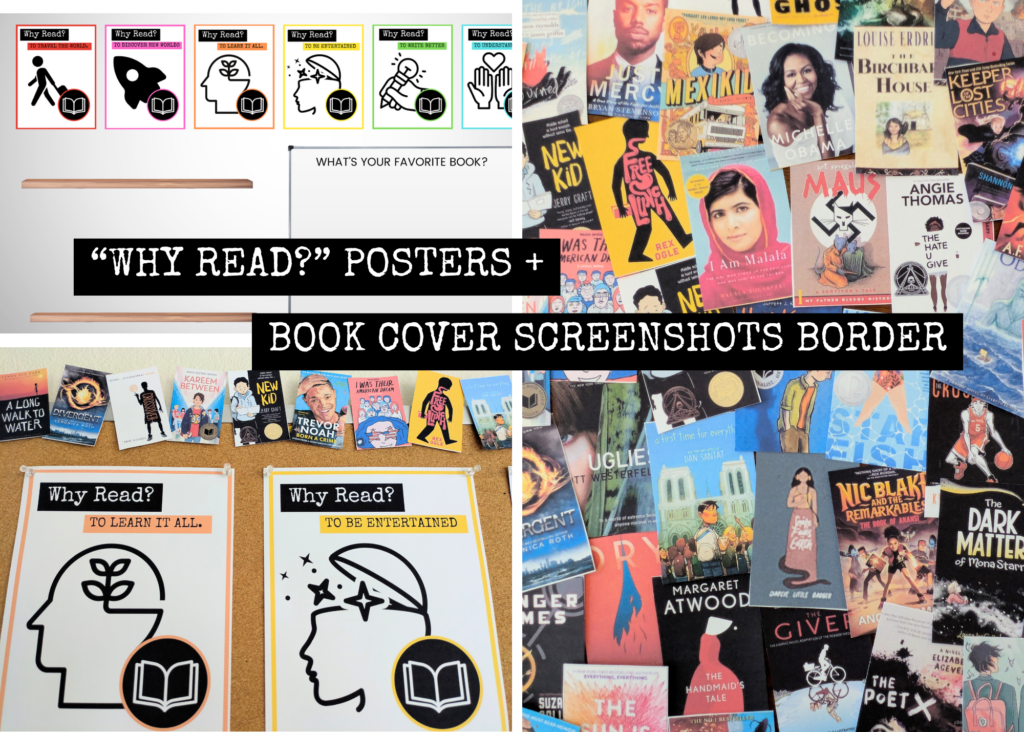
I do a lot of screenshotting book covers. I’ve got a folder on my desktop called “The Screenshots.” They’re handy for creating graphics to recommend books, and I do that a lot. These little cover screenshots can come in handy in many ways, but most recently I dropped them all into a Canva slide set and printed them so I had a huge deck of tiny books. The possibilities are endless. I might do it again to cover my door in a rainbow ombre of books, inspired by Donalyn Miller’s “Book door” concept from her book, Reading in the Wild, and a stunning rainbow book cover display I saw on Jarred Amato’s Project Lit instagram.
But for now, I used them to create a tiny and epic border around the bulletin board near my evolving classroom library. Where I also put up my “Why Read” posters (see element one!), my reading button collection, and a beautiful bookish tapestry I got from Tiff in the Middle’s Etsy shop. What I love is that the books I used to create the border mostly match the books in my library. So if students see something they want to read in that border, they can go looking for it on the shelf! You can do the same.
5: Add Elements of Classroom Surprise
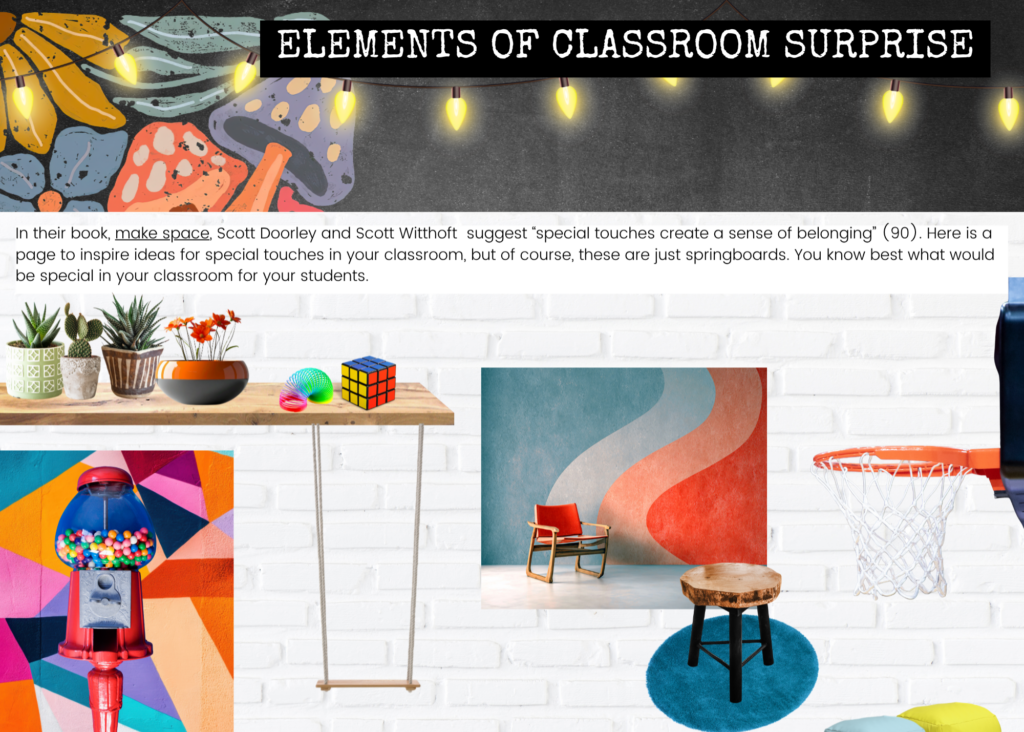
Remember when C.J. Reynolds was on the show? He had so many great ideas for building relationships with students. I went exploring on his Youtube channel recently in search of a video to help a friend whose students were feeling very hesitant to share their identities in class, and I found so many fun ideas for building connection. But I also got to see inside two of his classrooms and marvel at all the wonderful character touches there. Check out this video to see for yourself! His approach reminds me of the advice of Scott Doorley and Scott Witthoft of the Stanford Design School in their book, make space. They talk about the “special touches” that “create a sense of belonging” (90). CJ Reynolds shows a driftwood tree he built in his classroom, a painted skyline view of the city he taught in, and much more. Your classroom walls don’t have to focus entirely on ELA.
Maybe you love the national parks, and you want to create a corner full of parks posters, put a swing for readers there, and call it “Reading in the Wild.” My husband has a Jelly Belly Machine in his school office mostly full of Jelly Bellies but also featuring a few Bertie Botts Every Flavor Beans, and BOY does it generate a lot of laughing and conversation. I’m hoping to put up several swings in my classroom this fall, because I used to love reading on the swing in. my yard all through my growing up years.
Integrating interesting moments, surprising touches, and pieces of your own history can help make your classroom a place that is interesting and appealing for your students.
Don’t Forget to Sign up for Camp Creative
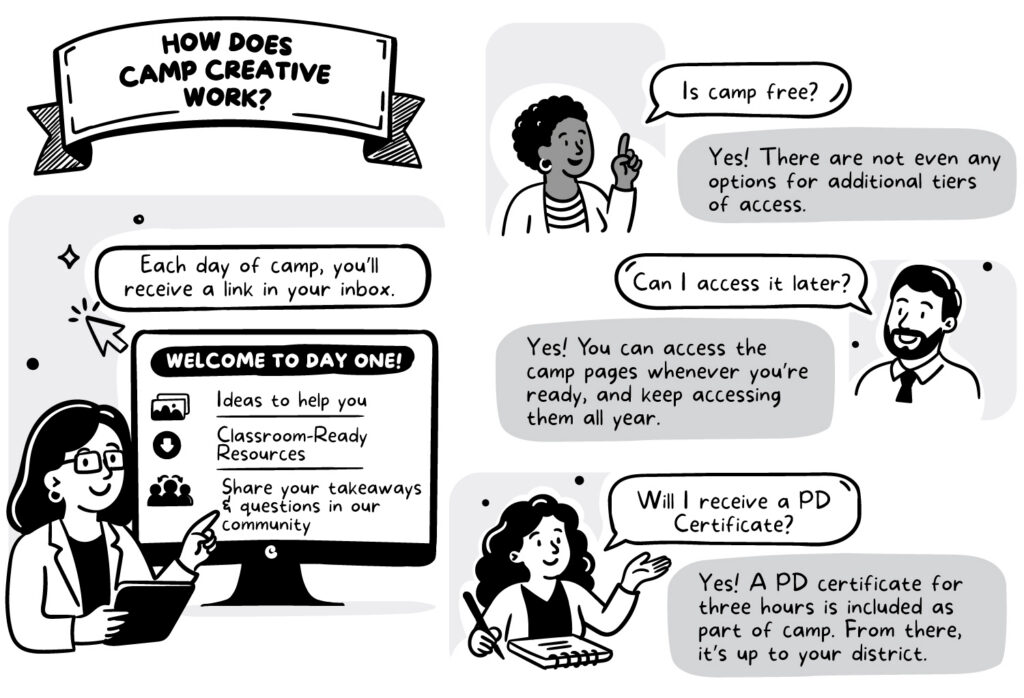
OK, my friend. I’ll be sharing all these poster sets and SO MANY more resources to help you kick off back-to-school with more style and less stress July 27-31 and I really hope you’re going to be there! You can sign up right here. Remember it’s free, async, and available all year long after camp (still free).
Here are some answers to the most Frequently Asked Questions that come up each year:
Sources:
Doorley, Scott & Scott Witthoft. make space: How to Set the Stage for Creative Collaboration. John Wiley and Sons, 2012.
Miller, Donalyn and Susan Kelley. (November 4, 2013). Reading in the Wild: The Book-Whisperer’s Keys to Cultivating Lifelong Reading Habits. Jossey-Bass.
Reynold, C.J. (2025). “Classroom Setup Ideas.” Teach Your Class Off Youtube Channel. https://www.youtube.com/watch?v=ILdUw5_FzVM
Richardson, Carmen and Punya Mishra. “Scale: Support of Creativity in a Learning Environment,” 2017.
Richardson, Carmen and Punya Mishra. “Learning environments that support student creativity: Developing the SCALE.” Thinking Skills and Creativity, Volume 27, March 2018, p.p. 45-54. Accessed online at https://doi-org.proxy2.cl.msu.edu/10.1016/j.tsc.2017.11.004, October 13, 2025.
Wiggins, Grant, and Jay McTighe. Understanding by Design, Association for Supervision & Curriculum Development, 2005. ProQuest Ebook Central, http://ebookcentral.proquest.com/lib/michstate-ebooks/detail.action?docID=3002118. Created from michstate-ebooks on 2026-05-22 14:52:21.