The countdown started yesterday in my kitchen, as my daughter flipped the calendar forward for something and realized she had less than thirty days of school left. She loves her teacher and looks forward to school, so she felt sad. It launched her into a story about how her class is trying to convince her teacher to move to the next grade with them. If you, too, are starting to plan ahead and think end-of-year thoughts, today I want to share a way to help students review and reflect on the year in one multimodal activity. I’ve had requests in The Lighthouse for ways to help students reflect on their own learning – to tell their own learning story. Research backs the importance of metacognitive reflection for students – in other words, it’s helpful for them to think not only about what they’ve learned, but also how they’ve grown and developed as learners, and where they might want to go next.
Before we dive in, feel free to grab the free curriculum that goes along with this episode. Everything pictured below and discussed throughout the episode is already set up to make this activity as easy to implement for you as possible! And yes, the handouts are editable so you can tweak them to suit your own twist on the activity.

Alright, let’s dive in. You can listen below, or on any player you prefer, or read on for the blog post version.
The Two Types of Hexagons
The first step in this activity is to give every student their own set of blank hexagons in gray and white.


The white hexagons are meant for the content of the units they’ve studied throughout the year. They can fill one or two up for each unit, including elements like these:
- meaningful texts from the unit
- your key takeaways from the content of the unit
- essential ideas or questions from the unit
- quotations from texts in this unit
- visual representations of key pieces of this content you’d like to remember
If they’re skeptical about creating visuals and using colors to help illustrate the content of the units, you might share this recent research analysis from Edutopia, from their School of Practice podcast, “The Extraordinary Impact of Drawing to Learn” episode: “When kids attentively sketch something they’re learning about, they tap into the visual, kinesthetic, and linguistic parts of the brain, research shows. This generates abundant connections across the brain’s neural network and encodes learning even more deeply than more passive learning tasks, like reading or listening to a lecture.”


Next come the gray hexagons, where they can look back one their own experience as learners. The gray hexagons are meant to show HOW they learned and changed as learners, as opposed to what they learned.
The learning hexagons can include elements like:
- reference to meaningful projects or writing you did during this unit
- notes about ways you expanded your perspective or evolved your thinking
- skills you developed or improved during this unit
- questions you still have related to this unit
- interests you developed as a result of this unit
- visual representations of meaningful work you did during this unit


Connecting the Hexagons
Once students have created hexagons for the units you’ve studied and the skills they’ve developed, it’s time to move into connecting – you know the thing we love about hexagonal thinking! There won’t be a right or wrong way for them to connect all they’ve learned in terms of content and skills throughout the year, it’s just a chance to see connections and reflect.
For example, as I created the model below, based on the ninth grade curriculum I’m developing for next year, the connection between Romeo and Juliet and The Outsiders immediately leaped out at me. On both hexagons I had created sections about what connects people versus what divides them. The stories of the Socs vs. Greasers and the Montagues vs. Capulets are so similar, but somehow I hadn’t thought about it before.


After students create their webs, you might consider holding a learning gallery, letting everyone stand up and travel around the room to see what others have taken away from the year. It’s another way to review and reflect, as they see what others’ consider to be the most important takeaways from every unit.
But don’t stop there…
Reflecting
Use this activity as a springboard into a final reflection. Invite students to tell the story of their year, in whatever mode(s) they prefer, starting with some jumping off questions like the ones below (they don’t have to answer every one! And certainly not in order!). The goal here is for students to think about their learning – what helps them thrive, what they learned that they care about, who they are as students and what next steps they want to take, etc.
- What stands out to you as meaningful?
- What are you glad to have learned?
- What skills have you developed?
- When did you most thrive, and why?
- What questions do you take forward into your next chapter?
- What strengths have you discovered that you’d like to continue developing?
- Who are you now, as a student of English?
Ready to try it? Don’t forget to grab the free curriculum to make it easy!
Original article on hexagonal thinking:
Hodgson, Anthony. “Hexagons for Systems Thinking.” European Journal of Operational Research: Volume 59, Volume 1, p.p. 220-230, ISSN 0377-2217, https://doi.org/10.1016/0377-2217(92)90019-6. https://www.sciencedirect.com/science/article/pii/0377221792900196. Accessed April 2026.
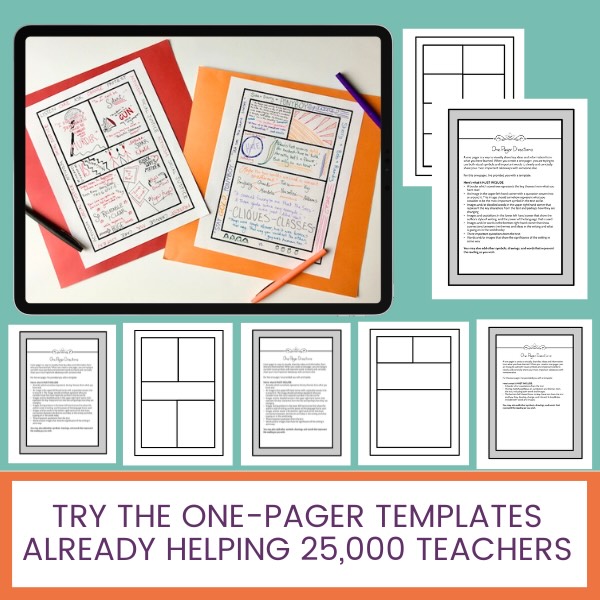
Original concept of the one-pager comes from AVID, though I was first inspired to create a template version after seeing various incredible examples of student one-pagers from other teachers and questions from my community about how to help students produce quality work.
As always, creating a new type of curriculum is inspired by the work of many educators and thinkers who have come before me, so thank you to Anthony Hodgson, AVID, and the many teachers in my network with whom I am so often in conversation about all our ways of remixing the possibilities.