So you’re teaching The Great Gatsby? In that case, let me start with a joke.

But seriously though, there’s SO MUCH to do with this book! And year after year, it’s one of the most popular options for our high school classrooms. In fact, it won the tournament I ran recently for English teachers to choose their favorite book to teach older students out of 32 popular choices. Thousands of folks weighed in, and here you can see the final results.

Check out that great list of quarterfinalists worth considering for your curriculum: The Great Gatsby, Long Way Down (teaching ideas here!), The Kite Runner, Trevor Noah’s Born a Crime (teaching ideas here!), Animal Farm, Fahrenheit 451, The Handmaid’s Tale, and Just Mercy.
I love that so many contemporary titles sailed to the forefront alongside Fitzgerald’s novel. But I digress. Today I want to share about all things Gatsby: text pairing ideas, discussion options, analysis activities, creative projects, group activities, and more!
Text Pairings for The Great Gatsby: Expanding Viewpoints on the American Dream
First things first, let’s talk about dreams. Specifically, the AMERICAN DREAM. If you’re in search of text pairing options for this classic, perhaps so you can bring in more diverse and contemporary voices to the conversation about American Dreams, and/or explore an essential question surrounding the American Dream, here are some ideas for you. Of course, as always when I share text ideas, please preview these texts to see if they are right for your age of students and community.
- Button Poetry: “American Dream”
- The NYT: (Re)Defining the American Dream
- Jose Antonio Vargas: Dear America, Notes of an Undocumented Citizen
- Graphic Novel: I was their American Dream
- Amanda Gorman: “The Hill We Climb” (video and text)
- Reyna Grande: A Migrant’s Story (Video)
- Langston Hughes: Let America be America Again
- Excerpt from Beautiful Little Fools, a Reimagining of Gatsby from the Female Perspective
- Facing History and Ourselves: What Does it Mean to be an American?
- Joy Harjo: “American Sunrise” – Youtube Reading
- The Project 562 Gallery
- The Sun is Also a Star (YA fiction) – film trailer
- Amplifier Art: We the People Campaign
- Ken Liu: The Paper Menagerie
- Gatsby’s Secret, by Wesley Lowery, and recommended to me by educator Maura Martinez
There’s a lot of great stuff here. Perhaps one of the most striking, for me, is “Gatsby’s Secret,” which Maura Martinez emailed me this year. Wesley Lowery makes the argument that Gatsby is a black man passing for a white man in the novel, and even considering this possibility is a fascinating shift in reading perspective.
If you want to go further with text pairings, check out this plan-my-lesson podcast episode for introducing the American Dream, and the multimodal dream gallery activity it pairs with (pictured below).


Choice Board Activities for The Great Gatsby: Free Download

If you’d like to build some choice activities into your unit, or just print 27 ideas for yourself for your unit, these (free) printable choice activity boards are perfect.
You’ll find activities to help students work on argument, practice their creative writing, look at the book from new perspectives, discuss aspects of the text with a partner, analyze themes and style, research context from the 1920s, try out multimodal activities based on the novel, and more.
Here are a few examples of the Gatsby choice board activities:
Imagine someone discovered a lost three paragraph scene from The Great Gatsby. Write it. It can start or end anywhere. It should somehow illuminate a character or setting, and show your understanding of at least one element of Fitzgerald’s style.
With a partner, discuss the role of The American Dream. Whose dreams are shown in the novel? Whose are shattered? How does “American” get defined? What other texts have you read that relate to The American Dream, and how do they compare?
Imagine you were in charge of choosing the main theme music for a new film adaptation of The Great Gatsby. Propose three possible songs, with a short paragraph for each explaining why it could make a strong theme (with reference to the text).
Do some research about the World Series Scandal of 1919. Why do you think Fitzgerald chose to include mention of this event in the text? Write a paragraph explaining what happened and how the reference to it helps shape the character of Jay Gatsby.
Find a partner and debate the question: Do the women in The Great Gatsby have a voice? One partner should argue that yes, they do, and give evidence. The other should argue that no, they do not, and give evidence. Jot down your main points as you go.
Consider the way references to time are woven throughout the text. Search out three to write down, then write a thesis statement related to the importance of time as a key theme in the novel.
You can grab your copy of these choice boards delivered straight to your inbox when you sign up for my (free) teacher idea emails below.
Close Reading Activity for The Great Gatsby: The Collaborative Annotation Gallery

The Collaborative Annotation Activity for Gatsby
Annotation can be such a challenge for students. If your students struggle to get past highlighting and random post-its, the annotation walk can help them learn to experiment with new forms of annotation.
Put several of your favorite close reading passages from Gatsby up on your wall, give students a guiding handout with types of annotation you’d like them to try, and then give them time to stand up and walk through the text gallery, trying out each of the forms of annotation on their guide as they wander the room and check of all the types of annotation on their list as they complete them on different passages.
They’ll get practice experimenting with their annotation, see what others do and learn from them, and, of course, dig deep into the text selections you choose to focus on.
Once everyone has completed their annotations, have students walk around looking at the passages as a gallery, learning from others’ observations. It’s a great launch into a discussion or writing activity.
Discussion Activity for The Great Gatsby: Discussion Role Cards

The Gatsby Discussion Role Cards
Discussion role cards are one of my favorite ways to mix it up in discussion. If your students tend to fall into ruts – the few kids who do all the talking, the kids who tend to remain quiet, the one who remembers to tie a thought back to the text directly, etc. – discussion role cards can help them get out of those ruts and try something new.
The cards you make can be specific to the text, like “Bring up the American Dream in this discussion” or “Ask about the role of women in this discussion.” Or they can be more general, like “In this discussion, try to make connections between the book and other books we have read or that you have read outside of class.”
I like to tape discussion role cards (here’s a free general version for any text) under students’ desks and then dramatically reveal that they have a secret role to perform in the discussion that no one else should see. For many students, having a specific role to play can help them try something new, and learn what their peers are capable of as well when the discussion isn’t dominated by just a few kids.

Context Activity for The Great Gatsby: The Jazz Age Student Podcasts

Inside the Jazz Age Podcast Project
If you’ve been around here for long, you know how I feel about student podcasting – it gives students a chance to experiment with a highly relevant 21st century medium, work on their writing AND speaking skills (and in this case research as well), and is easy to connect to a real-world audience.
Win win win!
If you haven’t run through my free PD “Camp Creative: Your Easy Roadmap to Student Podcasting,” you can sign up here.

For this Gatsby-themed podcast, invite students to research and showcase elements of the jazz age in a quick 90 second podcast. It’s a modern remix of the old context Powerpoint presentation. Students can dig into topics like: the World Series Scandal, bootlegging, flappers, jazz, etc. and then showcase what they’ve learned in a fast, fun, and furious pod episode to share back to the class. You can play the episodes back to the class as the topics arise in the novel, or do some choice listening at different points throughout the unit, letting students build their understanding of the 1920s from each other’s work.
Characterization Activity for The Great Gatsby: The Open Mind

The Open Mind Project for The Great Gatsby
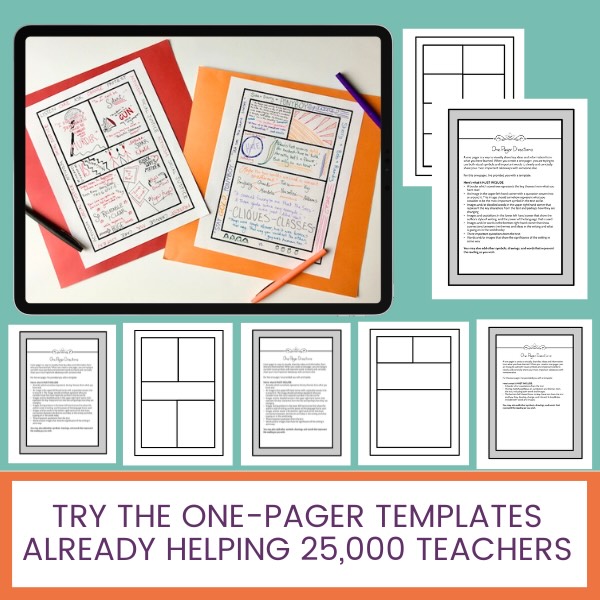
An open mind project is a twist on the one-pager that focuses on character analysis. Share a silhouette template and invite students to represent what’s happening in their chosen character’s mind – thoughts, dreams, connections, relationships, key quotations – making intentional choices about color and image representation. Ask them to think about what to put where and WHY, which colors and images to use and WHY.
Then comes the question of what’s happening around the character. In the space outside their head, what is influencing them? You can divide up the rest of the page and invite students to fill it with representations of key events, relationships, settings, etc. Whatever you feel is most important in helping showcase Gatsby, Daisy, Nick, Jordan, etc. with depth.
Color Analysis Activity for The Great Gatsby: Class Scavenger Hunt and Writing Practice

Color analysis for The Great Gatsby is a longstanding tradition, and as much as I wanted to create new ways of exploring this text, I couldn’t ignore it. For this collaborative scavenger hunt, invite students to choose a color group (blue, red, green, gray/silver, white, or yellow/gold) and work with their group to fill a color slide in a collaborative class slideshow with examples of how that color is used in the text. Now you’ve got a color gallery the whole class can use as a springboard to write or discuss color that day and possibly to return to later in your unit for more consideration.


Creative Writing Activity for The Great Gatsby: Themed Digital Blackout Poetry

Gatsby Digital Blackout Poetry
Creating digital blackout poetry saves Sharpies and gives every student – regardless of drawing ability – the chance to overlay graphics and color imagery onto their final blacked-out poem. (Grab a free guide to creating blackout poetry on paper and digitally here if you’re new to this wonderful genre). For this Gatsby remix, invite students to start with a key passage pulled from the novel, and then black out based on a key idea that comes through the passage. Maybe students will create a blackout poem showcasing Fitzgerald’s style, a key theme, a moment of character evolution, etc. In addition to creating an illustrated digital blackout poem, you can invite them to create a little card to display under it which explains their choices and ties them to the book, like you would see next to a piece of art at a museum.


Creative Analysis Activity for The Great Gatsby: Close Reading Storyboards

Storyboarding is a great tool to get students visualizing what they read, and using their critical thinking to make choices about how to represent the text.
What are storyboards, you ask? A storyboard is the tool folks in T.V. and film use to show how each visual scene will be shot. It looks like a comic book, and it works as a guide to show the composition, lighting, angle, camera movement, etc. for each scene. If you want a deep dive on how they work as a project option in ELA, check out this post.
Because Gatsby is so full of meaningful symbolism, color threads, and striking settings, a storyboard can be a great way for students to bring a key moment to life for themselves.


Have students focus on a relatively short time window – a moment of tension, the introduction of a setting or character, etc. It takes a lot of panels to cover mere seconds.
In each panel, students will want to make choices about elements like these:
Camera angle (high, low, eye level): What do you want to convey about the relationship of one character to another? How do you want the audience to see your characters or a particular character?
Camera distance (close-up, medium range, long shot): How much information do you want to include? What details need to be seen and which can be blurred?
Perspective: Whose eyes are you seeing through? Whose perspective do the audience members have? Or is the scene objective?
Composition: How do things within the shot need to be arranged to put the focus in the right place?
Length of shot: For how long do you need to show this? How quickly should you move to the next scene?
Sequence: In what order are you presenting information? Will the audience know everything it needs to in time for key events?
Lighting: Is the moment bright? Shaded? Dark? Are there spotlights? Floodlights? Is there moonlight? Firelight? How will the lighting change the viewer’s focus and the mood of the scene?
Looking for more Options for your American Lit Class?

Long Way Down is another potential powerful read for American Literature. Check out this complete introductory lesson and this roundup of activity ideas if you think Jason Reynolds’ novel-in-verse might be a good fit for your class.
Trevor Noah’s Born a Crime has also been a big hit in many classrooms lately, with so many important themes shared with Noah’s impactful humor. Check out this introductory lesson if you want to explore this text as a possibility for your classroom. (There’s also a YA version of this memoir, which does have some mature moments).