I bet you know your favorite way to learn something. Maybe it’s by listening to a podcast, skimming a couple of articles on the topic, reading a book, going to a live lecture, taking a Masterclass, talking to a knowledgeable friend, playing your way through an App like Duolingo, attending a conference…
The point is, we’re all pretty different when it comes to our FAVORITE way to take in information. The way that really helps it sink in.
For me, it’s often about visuals and color, dating all the way back to my high school years when I created my own visual notes summaries of the semester for each class before finals. I enjoyed reading through all my notes and condensing them into a couple of brightly colored pages. Once I had done that, I barely had to study those highlight reels, because the process of making them had done most of the studying for me.
Honestly, I looked forward to exam week because I could take my exams and look at my notes for the next day more quickly than I could get through the work of a normal week of school. I had more free time when we had tests, and I enjoyed my review process.
Today on the pod, as many folks may be headed into a unit or term review, just as student focus is already taking a left out of school city toward vacation land, let’s talk about an easy way to give students agency over their review, ANY review.
Today’s idea is simple – let students review in the way that works for them. With a review choice board, you provide agency through options for your students, walking them through ways to review and retain information and then giving them the freedom to pursue a route they’re most interested to try.
So what might that look like? Here are some options…
The Sketchnotes Version

Creating sketchnotes of what they’ve learned can help students review and think critically about what’s most important in what they’ve studied. As they read through their handouts and notes and re-make meaning out of them, they’ll make the information more memorable as well as they process it in a new mode.
Student directions for this choice board option: Look back through all of your materials. Concentrating especially on the areas you feel you know least well, create a sketchnotes version of the key concepts we’ve covered. Use colors, icons, text, and drawings to bring out meaning (this will also help you remember the information better).
If you’re new to skechnotes, check out this post: The Ultimate Guide to Sketchnotes in the ELA Classroom
Free sketchnotes templates to act as a scaffold for students who want them


The One-Pager
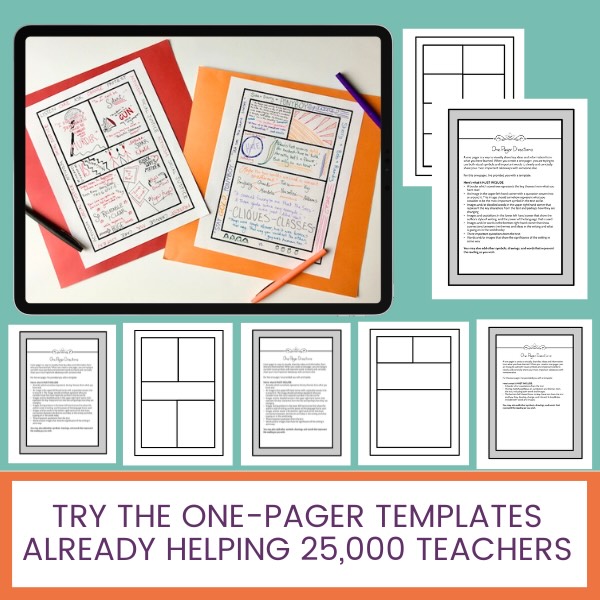
The one-pager carries similar benefits to the sketchnotes version, but invites students to condense even further down to a single page. This can be ideal for a single unit or a set of grammar, vocabulary, or writing terms you want to review, as opposed to an entire term. Although, I have seen teachers use a one-pager as a final exam – students just really have to prioritize the most vital information from the term and condense it carefully.
Student directions for this choice board option: Look back through all of your materials. Concentrating especially on the areas you feel you know least well, create a one-pager of the key concepts we’ve covered. Divide your paper however you wish in order to hit on whatever you think was most important.
If you’re new to one-pagers, check out this post: One-Pagers: The Simplest Way to Success


Craft your Own Game
Lately I’ve really enjoyed gamifying things students tend to struggle with, like writing a good thesis statement, exploring different types of sentence structures, understanding the underlying principles of MLA, and the essentials of rhetorical analysis.


The process of designing the game is an incredible review, since you need to decide what questions are important to ask and how they would best be answered. Plus, if students choose to create a game, then they can play it with others, giving them an authentic audience for their work and the chance to have fun playing with a friend as they review.
Student directions for this choice board option: Look back through all of your materials. Concentrating especially on the areas you feel you know least well, design a review game alone or with a partner. Your game can be of any type, as long as it helps the players review our materials. When you’re done, find players to play with you.


The Podcast Version
When students create a podcast version of their review, they suddenly have a review tool they can quickly access on their commute, while going for a run, while packing their school bag, in a free moment before bed, etc. Not only do they get the benefit of looking back across all their material and choosing what’s important to study, but then they say it all aloud and then LISTEN to it as much as they want. For kids who like learning by listening, this is a great choice.
Student directions for this choice board option: Look back through all of your materials. Concentrating especially on the areas you feel you know least well, write a script for a podcast version. Record your podcast using Vocaroo or your device, and then play it back to yourself to help you study. If you have time, listen to a partner’s.
If you’re new to student podcasting, you might want to sign up for my free PD, The Easy Roadmap to Student Podcasting.
The Flashcards
The traditional flashcards method can be a solid option for students who feel there are certain things they really want to memorize, like literary terms, vocabulary words, literary movements, etc. Consider inviting them to use the flashcard templates on Canva if you have a way to help them print their work (by the way, wish you had more Canva confidence? Here’s a free mini-course to help!)
Student directions for this choice board option: Look back through all of your materials. Concentrating especially on the areas you feel you know least well, create flashcards for yourself focusing on key information you want to remember. Find a partner and run through both your own and your partner’s set of flashcards together.

Partner Quiz
Finally, there’s the old standby, likely to appeal to students who are really in the mood to work with a friend. For this option, they run through their notes with a partner, taking turns quizzing each other across the material. This could work well in conjunction with another option too, like if the partners had just created sketchnotes versions, and had time left over when they’d prefer to be quizzing each other rather than silently studying their sketchnotes.
Student directions for this choice board option: With a partner, look back through all of your materials. Divide up the key areas you want to review and write questions for your partner about those areas. Then take turns quizzing each other with your questions.
Ready to Try it?
Feel free to project my version (below) if you wish, or to make your own version with some of these options and more of your own.