The word audience conjures up a crowd, perhaps people watching an opera late at night at the Santa Fe outdoor amphitheatre, as the moon rises over the spectacle of Cosi Fan Tutte. Or wearing sparkles and friendship bracelets as they scream themselves hoarse at the Eras tour. Or packing a stadium as they stomp their feet and cheer at a Lakers game.
But audiences don’t have to be so huge, or dramatic. When it comes to students, what they need is to know they’ll pretty often have one for their best work. A friend, the kids walking through the hallways every day, the school principal, the 2nd grade class at Wilson elementary down the street… it matters.
It changes the way they work, and helps their work parallel the writing they’ll do one day across a wide variety of careers, in which their emails will go to someone, their presentations will be to a room full of co-workers, and their social media posts will make the difference between their small business making it or not.
An authentic audience brings engagement and motivation, helping students be successful at school and beyond. So today, let’s talk about where to find it (hint… around every corner!).
One quick note before we begin – for any of these audiences that exist online, keep in mind that you would need appropriate parent and/or school permission for students to submit to be published, and that students should never share their personal information or photos of themselves.
Why Does Authentic Audience Matter?
I’ve often seen firsthand the power, for students, in knowing they’ll have an audience for their work besides me.
But I’ve also seen the evidence for this power reinforced by other educators in more contexts.
In their book, Best Practice, Zemelman, Daniels and Hyde write “The old idea that the teacher is the only legitimate audience robs students of the rich and diverse response from audiences that is needed to nurture a writer’s skills and motivation” (62-63). John Warner, long-time college composition professor, seems to agree in his book, Why They Can’t Write, sharing his best ideas for building better writing programs: “Students are more engaged when they believe the writing has a place in the world beyond school or an assignment” (151). One of my previous guests here on this podcast, Eileen Landay from Brown, and her co-author, Kurt Wooton, say the same in their book on arts integration in ELA: “When performances are presented to real audiences for a real purpose, students are more likely to take the quality of their performance seriously and craft and shape their work with great care” (28). It just makes sense, right?

So if logic, experience, and research all lead us to believe that authentic audience matters, what next? Where do we find it?
Authentic Audience within your Classroom
Let’s start with the easiest, most accessible option. For these authentic audiences, you don’t even have to leave your classroom.
Gallery walks: Gallery walks are perhaps the easiest authentic audience go-to. You can probably build one in almost every week, letting students turn their papers outward on their desks and head out to peruse other’s work.
Tape it up: In a quick spin on the gallery walk, have students work right on your walls, whether they’re annotating giant versions of poems, building a hexagonal thinking web, or brainstorming in a rainbow of post-its. Let them present back to the group at the end, or walk from wall display to wall display, taking in each others’ ideas.
Performance: Reading theater? Build in a performance element. Maybe it’s a progressive performance (my personal favorite), groups acting short scenes, a monologue contest, or…
Performance Poetry: A performance event is a solid win for any poetry unit, whether it’s a slam, a jam, or an open mic. It gives a new fire to every writing workshop, as students know they’re writing something that might eventually end up in their mouth on stage.
Creative Writing Showcase: Spin your creative writing unit to lead into a sharing event in class, whether it’s a one-act play festival, a graphic novel-style story museum exhibit, or a scary storytelling festival.
Display Lines: My favorite classroom display is a simple ribbon or piece of string strung between two Command hooks and filled with tiny clothespins. It costs about $2 to put up, and gives you the easiest, quickest possible display option in your room. Having displays like these, where you can easily change out work in a few minutes throughout the year, allows you to show student work regularly without spending hours taping it up. It provides one more dimension to your authentic audience options in class.
Authentic Audience within your School
Mentorship: Perhaps your students could visit the class just below (11th grade visiting 10th, etc.) for a writing partnership. Students could show each other a piece of writing they’re working on and give each other feedback. The older students could mentor the younger ones, but likely the younger ones would also be able to ask helpful questions and provide encouraging compliments too.
School Exhibits: That clothesline with clips trick would work well in your hallway too, or out at the front of the school. Providing gallery spaces in the public areas of your school where you can put up student work is another quick and easy way to provide audience, this time a bit larger. (Be careful not to display any personal projects or writing in these public or classroom spaces without permission).
Community Participation: In a twist on the school exhibit, try letting your students lead a community writing event. For example, if you’ve worked on six word memoirs in class, you might create a display in the school and then have students staff a table over lunch for a week inviting students to contribute their own six word memoirs to your display.
Invite Admin In: This is something I did a lot of, and I never regretted it. Not only does it provide authentic audience, but it helps build a bridge between your classroom and your administration, helping them see the create work your students are doing and why it matters. It’s easy – simply drop an email to your principal or department head, college guidance counselor or assistant head, etc. inviting them to see a performance, drop in on a film festival, be a judge in a poetry slam, attend a gallery, etc.
Invite the Media: Similarly, when your students are doing something fabulous, don’t be shy about acting as a PR agent. Invite a photographer from the school newspaper, or the local newspaper. Help your students learn to write a press release. Send it out.
Take a Project Out: There may be classroom events that just easily take place somewhere else on your campus, adding that extra flavor of public performance. For example, when we were reading the Canterbury Tales, all my students wrote their own tale and we had our own storytelling contest. But rather than have it in our classroom, we went on our own “pilgrimage” around the campus, winding up with a party in another location. Anyone walking by might catch a student story as it was being performed, and that was fun.
Go QR: While students may no longer have their cell phones during school (yay), parents and teachers do, and kids will after school. So exhibiting via QR codes can still be a fun way to showcase great work. Let students know as they begin a digital project that they’ll be creating a QR code poster leading to it to showcase in an online gallery somewhere in the school.
Access the Newsletter: Likely your school or district sends out parent blasts now and then, and likely they’re always looking for positive stories and photos to showcase. As student begin a podcast project, or a video documentary, or whatever, you might let them know you’d like to share some of them (with permission) to the parent community in this way.
Create a Mural: Every time I travel, I search out street art. It makes me so happy to see bright, colorful murals on the sides of boring gray buildings. I wish there were more in the world. Which brings me to this option, the school mural. Whether it’s painted right. the wall or on a big piece of plywood or corkboard, maybe your students could create a literary mural for a public space at your school. So many possible themes, but “Why Read” comes to mind…
Book PR: If choice reading and building a reading culture is a significant part of your class (and I hope that it is!), you can help empower students to see themselves as reading leaders by giving them an authentic audience for their recommendations as they find more and more books to love. They might be in charge of a library display each month, add a book review to school announcements, submit book reviews to the school newspaper, create pop-out review bookmarks for the librarian to put in popular books, or visit other classes to do book pitches for their favorites.
School Solutions: If there is something your school is struggling with, perhaps you could activate your students as designers to help solve it. That could be how to handle AI (try this free PBL unit), how to welcome new students, coming up with new elective possibilities, changing the schedule, etc. The “School Solutions” workshop pictured below is a nice way to start (make your copy here).

Authentic Audience with Younger Students
Publish and Read: Maybe your students are creating children’s books based on novels, or writing and illustrating their own from scratch. What better audience than the 2nd graders down the street?
Perform a Play: When Pernille Ripp came on the podcast, she shared her wonderful idea of having students create short plays based on Mo Willems’ Elephant and Piggie series (SO funny) and then perform them for younger kids. Whether you mimic this lovely plan, or come up with your own performance project, younger kids can be an enthusiastic and unintimidating audience for student performers who might be a little nervous.
Lead a Writing Workshop: Perhaps your students could run a writing workshop for a younger class, using pieces they’ve written and favorite pieces they’ve read as mentor texts.
Community Audience
Portfolio Sharing: Long ago I read a book about student portfolios, and search as I might, I can’t find the name of this lovely book. It was “Room” – something, some number. In it, the author shared about her experience running a portfolio-based curriculum. When students completed their extensive, beautiful writing collections, they knew they’d be sharing them with a trusted adult in their lives, and that that trusted adult would receive a request from their teacher to write them a letter in response to their portfolio. She wrote them a letter too, so they had an in-depth, extensive response from two people, one of whom wasn’t at all related to grading or skills, but rather entirely to content and connection. While you may not want to do long-form writing portfolios with your students, you can borrow this idea of sharing with a trusted adult in whatever form you wish.
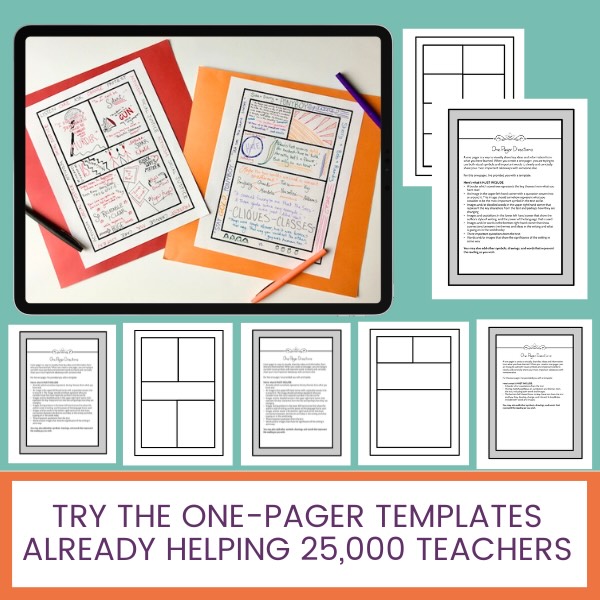
Invite the Community: Some projects, like a literary food truck festival or one-pager fair, might lend themselves well to inviting the community in. Perhaps you could even organize a coordinated event where multiple classes exhibit the same project (like a science fair) in your school gym, or even kids from multiple schools.
The Public Library: Getting to know your local librarians well is good for many reasons, and one of them is that your library could be a great venue for authentic audience. Student might exhibit poetry, “publish” versions of stories or children’s books to a display or come in to do a reading or performance.
The Coffee Shop: Many independent coffee shops and cafes exhibit a regularly changing rotation of public artwork on the walls. Perhaps one near you might like to exhibit multimodal work from your students, like the best blackout poetry from your blackout poetry workshop, or multimodal flash verse pieces.
Community Mural: Did you have success with a school mural? What if you contacted local artist or organization about collaborating on a literacy mural in the city?
Community Mentors: Sometimes you can embed an audience within a project arc, by bringing in community mentors to help guide students in their work. A day in which local businesspeople provide feedback on genius hour projects or nonprofit pitches, or a writer from your community gives a short presentation and then works with your students on their drafts, can provide a mid-project audience that makes an impact.
Judges: Perhaps you’re going deep with a debate or mock trial, a film festival or business pitch fair? Judges from the community can add to the excitement on the final day.
Performance: Perhaps your top performers in a speech contest, poetry slam, or scene performance might advance to a community performance at a senior center or city-wide event.
Authentic Audience Online
Overseas Exchange: When I lived in Bulgaria, my tenth graders shared writing back and forth with a class in Washington D.C., and my 12th graders had portfolio partners in Kansas. These classroom partnerships provided an authentic audience and a unique opportunity to learn about life in another country, especially for my younger students who were sharing writing around the theme of “home.” We talked about setting up an international exchange like this back in episode 158 with educator Andrea Greer, if you’d like to go deeper.
Reviews: You can experiment with online audience in a low-stakes way by having students work on writing reviews. With parent permission, students might post reviews for books, movies, local restaurants or businesses, or products they’ve purchased.
Online portfolios: If you have students create digital portfolios of their work, it becomes easier for them to access and comment on each other’s work. For example, I taught a blogging elective once where the students’ blogs were essentially their portfolios, and I linked each of their blogs from a class blog. After we wrote a certain type of post, they could easily go and look at other students’ versions and leave comments. Of course, students also enjoyed seeing readers pop up around the world for their blogs.
Submission: Depending on the type of writing you’re doing, students might be able to submit poetry, guest blog posts, articles, essays, opinion writing, or letters to the editor on various sites. Several of my students had their “This I Believe” essays published on the NPR website and they were thrilled!
Authentic Audience through Contests
The NYT Student Contest Series: The New York Times runs many student contests each year. Check out their Podcasting contest, Tiny Memoir (100 words) contest, Open Letters Opinion Writing writing contest, and more through their full calendar here.
Scholastic Art & Writing Awards: This one is worth checking out for your creative writing units.
Jane Austen Writing Contest: Teaching Pride and Prejudice? Or a Jane Austen book club unit? Check out the Jane Austen Writing Contest!
Host a Contest: Perhaps you could join with a local organization or business to start a writing contest in your area, with your students managing the contest and choosing the top finalists or even the winners. There would be a LOT of great discussion of what makes a good piece of writing such a project…
The NPR Student Podcast Challenge: Running a podcast unit? Enter the NPR Student Podcast Challenge!
Authentic Audience through Social Media
School Socials Takeover: Does your school have a social media feed for families? How about a student takeover to showcase the wonderful things they’ve been doing? Students could make videos, carousels, posts, and stories about their work on a project – OR, the takeover could BE the project and they could learn about journalism and social media management by showcasing positive school stories to the community. You could start by looking at a mentor text like Humans of New York (choosing which posts would work well to showcase as examples).
Public Library Socials Takeover: Similarly, your students could help create social media or the newsletter for the local library, showcasing and reviewing books they are loving in your choice program for other readers around your city.
Teaching Channels: Teaching something to others is so helpful in learning it – you could set up a class channel on any platform to help other students learn some aspect of ELA, and then build an ongoing project to fill that channel. For example, an Instagram with illustrations of vocabulary words you encounter in your reading, a podcast with grammar tips students are integrating into their writing, or a TikTok feed of craft writing moves students are experimenting with as they discover them through mentor texts. As students teach others, they’re also reinforcing their own learning and providing an ongoing review option to the class.
Guesting: Many book review and teaching podcasts exist out there. Perhaps they would like to feature a student guest or panel of guests, sharing their perspective on a theme like “Why Graphic Novels should Count as Reading” or “The Top 10 Books every High Schooler Should Read, According to Actual Students.” Students could learn to make an episode pitch, write a query email, and, if accepted, how to prepare for and take an interview.
Save it for Later
Want to remember these to tap back into later? Pin the graphic below!

Sources
Landay, Eileen and Kurt Wooton. A Reason to Read. Harvard Education Press, 2012.
Warner, John. Why They Can’t Write. John Hopkins University Press, 2020.
Zemelman, Daniels and Hyde. Best Practice. Heinemann, 2005.