A few weeks ago I shared my dream American Lit curriculum here on the pod, and soon after I heard from a British Literature teacher who was hoping for some new unit ideas for her curriculum too. She shared her starting point, which sounds like a highly engaging set of texts: “Our long reads,” she wrote, “are The Princess Bride, Macbeth, Hitchhiker’s Guide to the Galaxy, and Beowulf– a hero’s journey theme!” So today I’d like to brainstorm with you, throwing out ideas for a British Lit curriculum, based on some of these starting texts and a few more I’ll throw into the mix. Get ready for a Holmes-inspired True Crime podcast project, Shakespearean book clubs, a mashup of dystopia and contemporary street art, and more. Whether or not you teach a British Literature course, I think you’ll find some fresh ideas and inspiration for new unit possibilities today.
Princess Bride Storyboards
Let’s start off today with The Princess Bride. My husband used to teach this one, but I never have. I have, however, seen the movie version a dozen or so times. It’s a wonderful adventure story, fantastic for exploring the hero’s journey, which is a key theme for the teacher who wrote in with the request for this episode. What I want to contribute here, with the fame of the movie in mind, is the idea of doing film storyboards for scenes in the book. Because the film adaptation is so popular, it’s a natural opportunity to consider how a story can be illuminated in a new mode. You can take key moments in the text – perhaps ones that illustrate the hero’s journey, and invite students to choose one to storyboard for their own film version.

Find this full storyboarding curriculum in The Lighthouse multimodal section or on TPT here.
Once students have explored storyboards for other films or television shows, learned about the different elements they can use to interpret the text on film (like camera angle and distance, perspective, framing, lighting, sounds), and created their own storyboards, share them back to the class. Consider having students include a creator’s statement beneath their storyboard on the wall, explaining how they used their elements to interpret an aspect of the hero’s journey. Finally, watch the scenes in the film that make up the hero’s journey (or the whole film, but highlight these moments as they watch). Finish with a reflection on interpretation – students might compare either their own storyboard with the film scene they saw, or the storyboard of one of their peers with its matching scene.
Shakespeare Book Clubs
OK, this next idea might be challenging, and it depends on your students’ level and confidence. Certainly Shakespeare makes a great whole-class text, because there is so much to figure out. At the same time, with a whole group, you can only keep a few students at a time active on stage if you’re acting out the text in class. Given this, and the fact that there are just SO MANY amazing Shakespeare plays that are going to appeal to different kids for different reasons, I want to at least raise the possibility of Shakespeare book clubs.
I would offer four texts for the clubs: Macbeth, A Midsummer Night’s Dream, Romeo & Juliet, and The Tempest.
We’ve talked a lot here before about how to set up a structured book clubs that is not TOO structured. With Shakespeare, I would intermix a lot of activities and conversations for the whole group with the individual meetings. Together as a class you can explore Shakespeare’s context and the Globe theater, watch Akala’s Ted talk about Hip Hop and Shakespeare, warm up before acting days with acting games, examine helpful theater terms, look at modern adaptations of Shakespeare and the role he plays today. You could even dip into the opening of each play to help set up the groups for success and let everyone get some context for what their peers will be reading and bringing to the table in full group activities. Also, I would certainly want to have copies on hand of Gareth Hinds’ graphic adaptations of Romeo and Juliet and Macbeth during this unit as resources. (Ooh, and likely of Beowulf for that text).

When students were meeting, I’d structure some of the days by going outside or over to the gym (or some other larger space) where students could read their scenes aloud and block them out. I’d likely structure one day with hexagonal thinking for every group. One with exploring the text on My Shakespeare or doing some guided exploration of the Royal Shakespeare Company’s digital media to see some bits and pieces of modern interpretations on stage.

I would try to hold some discussions around big themes and ideas from the plays in which all students could participate, based on their own individual texts, probably using the Harkness method of student-led discussion (though a silent discussion or Socratic Seminar could also work well).
As a culminating activity, I would ask each group to either act a key scene back to the whole group, with an introduction to contextualize it, or invite lightning performances, in which they write and perform a super-speed version of the play.
As you can tell, I don’t have this 100% figured out yet, more the nut of the unit. I could easily do a whole podcast just on the concept of Shakespearean book clubs. But for now, I wanted to share the idea and let you go with it in your own directions if it’s interesting to you.
Pride and Prejudice
As a huge fan of Austen, I have to suggest including either Pride and Prejudice or Jane Austen book clubs in your British Literature course. Here I would want to explore the theme of art and influence, or perhaps “writing for change.” Understanding Austen’s context, and her feminism, would be a core part of this unit. I’d want to extend it well beyond Austen’s small corner of wealthy white British society though, perhaps inviting students to choose a writer (or creator, across modes) of their own who used/uses their voice to try to create change, reading or consuming content from this creator, and somehow presenting back what they’ve learned about art and influence. This would help focus students on the idea that many writer’s have specific purpose as they create, and they are thinking about their audience and how to wield their influence. Again, there’s much more to flush out here about what this would look like, but that’s a starting point.
Pride & Prejudice is one of the most adapted texts that I’m aware of, with film versions galore. You might create film clubs following your reading, letting students choose between the many versions to watch and report back on to the group. Maybe every club would choose a single scene to show back to the full class, presenting on why they chose that one and how that scene shows the overall interpretation of the text carried out by the writer/director/producer team.
I might finish up this unit by having students write (or create, across modes) a piece designed to change minds. That might be an opinion podcast, a social media series, a short film, a performance poem… but it would keep the idea of a specific audience strongly in mind, helping students focus on purpose as they create.
Performance Poetry
If you listened to my episode on my dream American Lit curriculum, you know I think performance poetry is the key to unlocking student interest in poetry in general. So I would want to devote a week or two to contemporary and canonical British poetry, with a special motivating focus on performance poetry. Britain has the delightful world slam champion, Harry Baker, who I first learned about from Melissa Alter Smith over at Teach Living Poets, and I definitely think his poem, “Paper People,” belongs in every BritLit curriculum!
You could go on a search for other British slam poets your students would like, perhaps starting with this helpful playlist. With 6.5 million views, “I will not let an exam result decide my fate” is clearly resonating with a lot of people, so that would be one to consider. Both this poem and George the Poet’s “My City,” have been developed as performance poetry films, which might be an interesting option for a multimodal project if you don’t want to do an actual poetry slam. You could do a poetry film festival instead, having students record their own spoken word poems as voiceover, then film B roll to stitch together behind their words.
With either of these overarching projects, you can explore various British poems, movements, and terms, and and do creative poetry writing workshops, all with the goal of increasing student mastery with poetry in order to write and perform a meaningful poem of their own. Again, we talked about this type of vehicle for a poetry unit in our American Lit curriculum episode, and it is just the same here.
Holmes and True Crime
Sir Arthur Conan Doyle’s Sherlock Holmes stories are so unique, and they’ve been woven so deeply into contemporary culture, it seems worth exploring a story or two in a British Literature class. Plus, they tie in beautifully to the current obsession with True Crime. While I’m not a True Crime fan myself, scaring easily, if you ARE, I’d like to suggest weaving together a small unit involving Holmes, True Crime podcasts, and narrative writing which includes the development of suspense and tension. Perhaps students could create their own “True Crime” podcast featuring the crime from a Sherlock Holmes story, using the form and tropes of a contemporary audio genre in play with the form and tropes of Doyle’s mystery writing. OK, I’m so excited about this idea, I really hope you run with it.
Dystopia, Propaganda, & Street Art
Finally, I want to dip my toes in the British dystopian waters. Here I’d want to craft a unit around Orwell and Banksy, two artists trying to impact their audiences in very different – but connected – ways. This unit could pick up on the themes from the Austen unit (and certainly some of the British performance poets) about the artist as an influencer, but maybe bring up an additional question: What’s the difference between propaganda and art meant to influence?
This is a question I came to after reading 1984 with my students in Bulgaria (a country with a Communist past in recent living memory). Many of them were horrified by Orwell’s fictional portrayal of their country’s former political system, and felt it was unfairly trashing it. They felt, I think, that I was essentially making them read anti-Communist propaganda. Our conversations became much richer and more helpful when we began to consider the spectrum of influence, attempting to define the line between propaganda and art, and to define elements of influence.
This unit could look at Orwell’s life and work and Banksy’s life and work, and maybe invite students to choose a street artist or dystopian writer around the world that interests them, and create a multimodal piece showcasing that work and how it fits into this spectrum of influence.
I would definitely want to include a look at Banksy’s huge-scale project, Dismaland, in this unit.
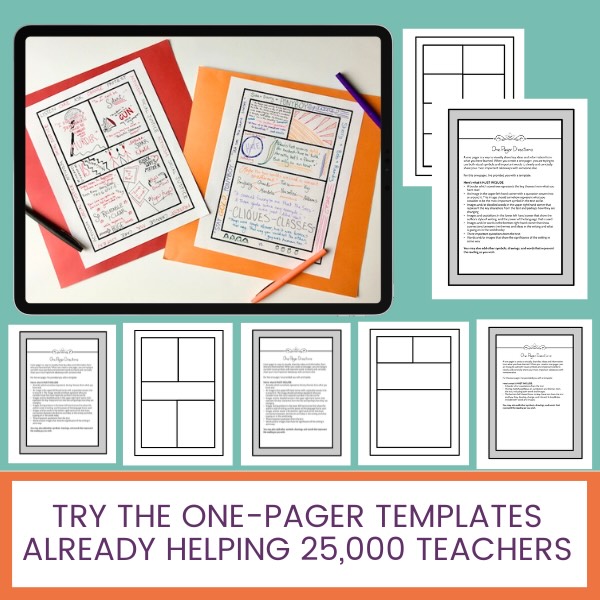
I might also incorporate a one-pager exploration of the big themes.


Your Turn
Well, this was fun! I hope you found some platforms for inspiration here, and that a new unit is coming together in your mind for one of your courses – BritLit or otherwise.