When you think back to your high school English classes, is there a certain activity that really sticks with you? One lesson or project that still hums through your brain and puts a smile on your face when you look back? I have a feeling that today’s guest, veteran teacher Wendy Eberhardt, will have a lot of students who look back on their lives in high school and think about the activity she’s about to share with us. I don’t want to ruin the surprise, so let’s just say that Wendy has come up with an incredible way to help her kids find their voices, and she’s about to give us all the details.
Introducing the Form: Panel Specifics
As a veteran high school English teacher working with students in grades 9-12, Wendy already had a lot of great short-form discussion options in her toolkit, but she wanted a cumulative discussion option. Something larger, more in-depth, that she could use at the end of a research project. Something that would allow for a deep dive into the material and give students authentic purpose.
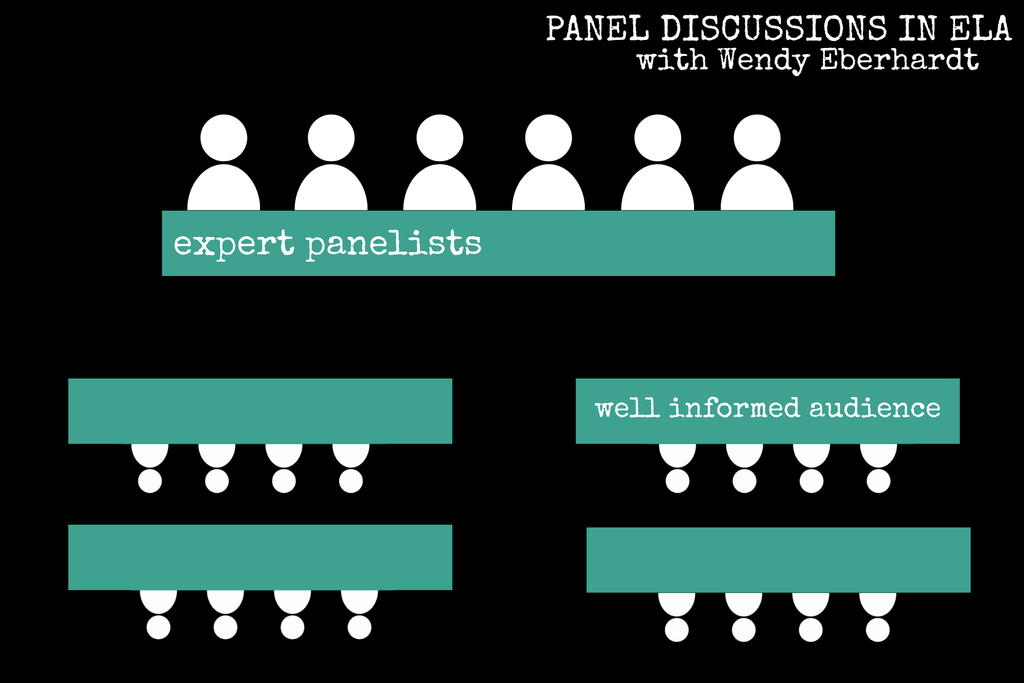
She decided to try centering students as experts, in a round-table type of discussion she chose to call a “panel” since her tables weren’t round.
And the rest, as they say, is history.
This has become a popular, repeatable, go-to option for Wendy and her students, beginning in 9th grade and continuing all the way up until they graduate. Because yes, Wendy is their teachers all four years, so she can guide them through increasingly complex iterations as they get older.
Here’s the basic overview…
On the day of the panel discussion, Wendy projects a formal welcome sign to set a professional tone. Several tables at the front house the expert speakers for the day (all students of course), as other students and potentially other teachers and administrators sit in the audience to see these well-prepared experts discuss the topic at hand. There’s a feeling of formality, thrill, and authentic purpose as students take the stage. Wendy has set the scene to help everyone understand how big this day is.
Sound pretty great, right?
Now let’s go back a bit here, to understand how Wendy and her class got here, and how you can do it too. Heads up, Wendy has put a great guide together for you which I’ll link at the end and right here too).
Helping Students to Prepare for a Panel Discussion (Content)
First, Wendy notes, it’s good to understand that you can do all different types of panel discussions.
She starts with mini-panels with her 9th graders, which will last just 5-6 minutes. These can be the product of shorter research periods or discussions of literature, and she scaffolds their process along the way with plenty of short discussions and quick writes to help them build confidence and get used to talking to each other.
Her tenth graders will be ready for a little more intensity, with 10-12 minute panels, preparing for a few days or even a week.
And then there are her BIG panels, with juniors and seniors, for which they might take 2-3 weeks to prepare in a research context, or several days to prepare at the end of a literature unit (since they’ll be building on all of their discussion and work with their text along the way).
Bottom line? Preparing for a panel discussion is a flexible thing.
It depends on the age of your students, how much research or literary analysis you want them to dig into before their discussion, whether you are making it a major summative and inviting guests or seeing it more as a practice, etc.
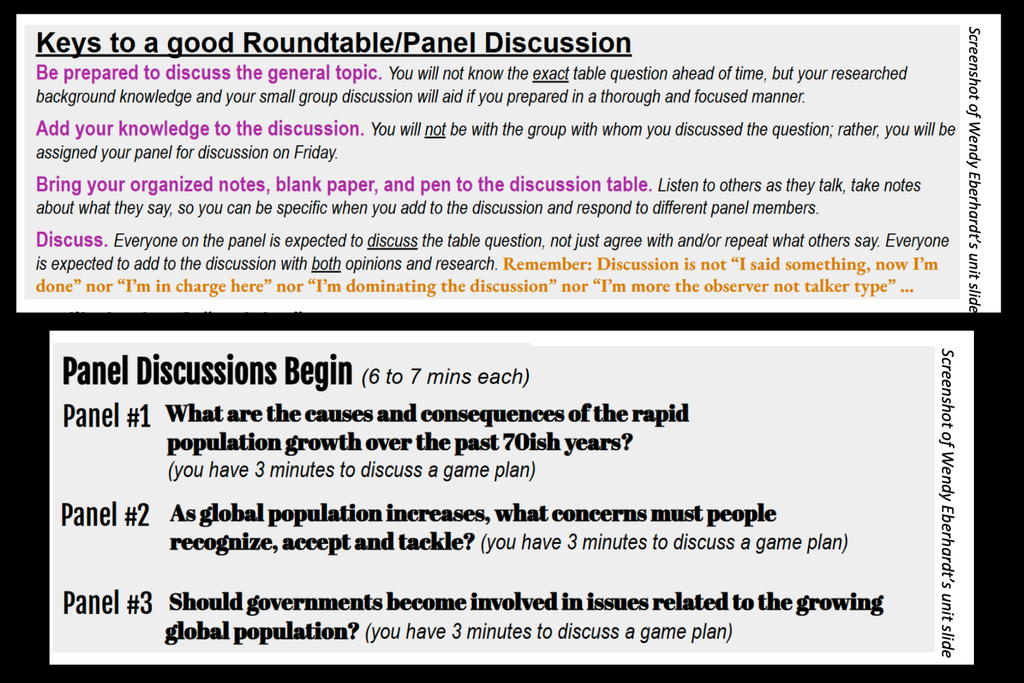
The key is, when the big day comes, students need to be ready to speak about the big question they’re presented with for the panel, based on previous research, writing, analysis, conversations, etc. Below, you can see the round table guide Wendy shares with her students, as well as an example of a round table question series for a set of mini-panels.
Besides helping students prepare to speak about the content, they need to be be prepared for the form of the discussion they’re jumping into, which brings us to…
Helping Students to Prepare for a Panel Discussion (Format)
When Wendy first decided to try panel discussions, she watched a LOT of them.
Fun ones, super serious ones, boring ones… SO MANY panel discussions!
She wanted to find two or three that would help students understand the form. She wanted them to see positive aspects of a panel discussion, and why this form could be relevant for them.
She also wanted them to see potential problems, and be able to call out issues with speakers as things to avoid in their own panel discussions.
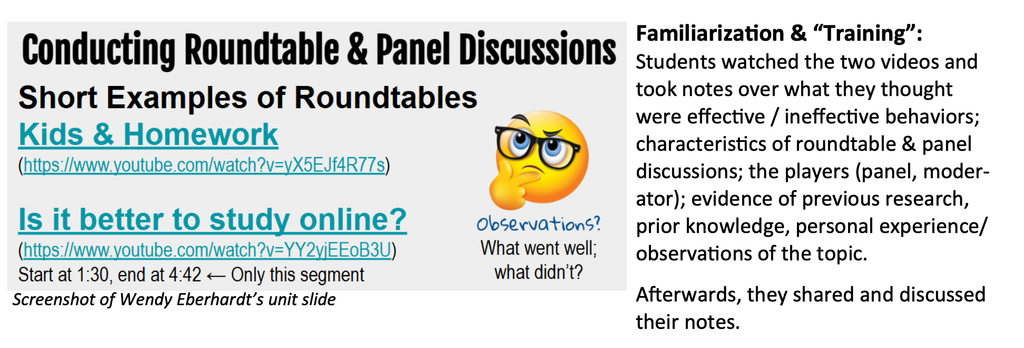
Screenshot from Wendy’s guide to Panel Discussions
Showing kids examples of panel discussions was the first part of their format prep, but she also taught them frames and scaffolds to help them speak respectfully to each other during the discussion.
For example, she might show constructions such as: “While I understand what you’re saying, X, I disagree with you and I want to say…” or “Earlier X said…., I’d like to add to that…”
She works with them so they understand that in a panel discussion, it’s essential that no one is belittled or made to feel that they don’t have value.
The Day of the Panel Discussion
For a big research panel discussion, kids will be presented with a question or challenge that is connected to everything they’ve been studying.
One of Wendy’s favorite research panel units focuses on Resurrection Biology, a topic most students aren’t familiar with.
After they’ve researched and discussed big ideas along the way, she gives them a prompt leading into the final panel. With just a little more time to research and prepare, they find out they must discuss and decide, as biologists, what to do with a large piece of land to help the planet.
Will they bring back an extinct animal? If so, what animal and why? What will they need to do to prepare for that? What will be the ramifications of the decision? Or will they, instead, try to protect an endangered species that is going extinct?
For this panel, the audience is seen as a group with the money to fund or not to fund the panel’s research, providing an authentic audience for the discussion at hand.
Panels for this discussion will last over several days, as students take turns as panelists and audience members with the power of the purse.
Help from Wendy
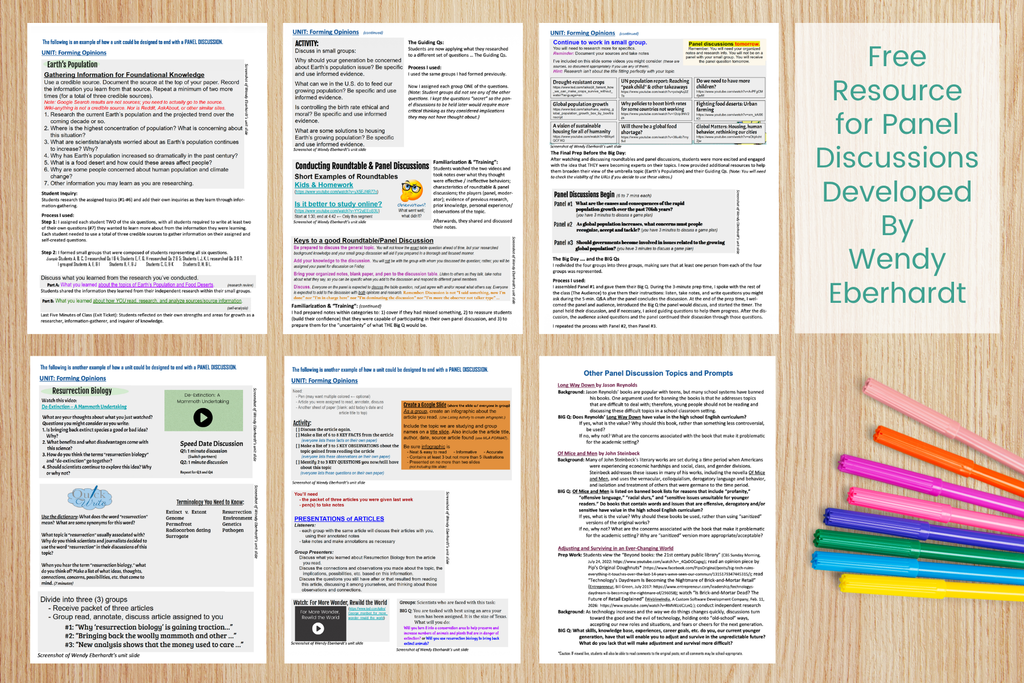
Ready to jump in? You can grab Wendy’s complete walkthrough of her process for several different panel discussions right here. You’ll find guiding questions for students, format tips, group guidance, topic ideas, and so much more! Wendy is sharing gold.
This is such a great form to try.
As one of Wendy’s students put it, “The panels helped me find my voice and my place in discussions when I used to always be scared to say my thoughts.” What a gift.
Learn more about Wendy
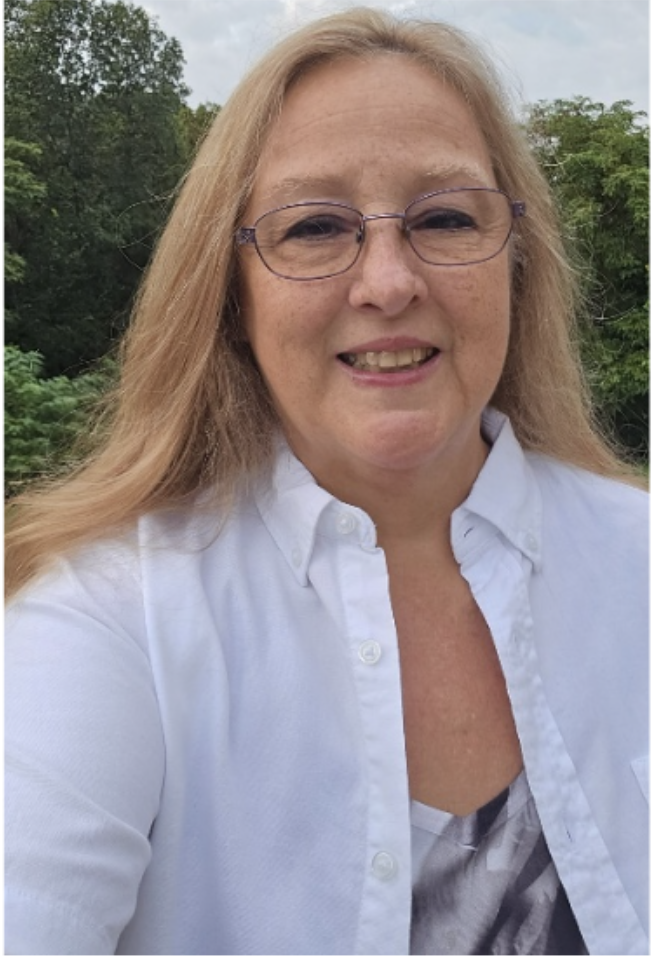
Wendy Eberhardt – or Mrs. E. to students and colleagues – teaches high school English at Green City R-I in Green City, Missouri.
She holds both a Bachelor of Science and a Master of Art in English Education and has completed additional coursework in Special Education, Learning Disabilities, and Elementary Education. She began her career in 1993. While the high school classroom has been her primary setting, she has been an adjunct instructor in both Missouriand Michigan, and she served for sixteen years as the Academic Programs Coordinator for the Lake Michigan College Upward Bound program.
Eberhardt strongly believes that “as long as we’re breathing, we should be learning.” She actively pursues opportunities to grow professionally, including spending much of her summers in personal PD studies that have recently included an online book study of Kelly Gallagher’s To Read Stuff You Have to Know Stuff, Missouri’s Literacy Summit and The Missouri Writing Project’s Summer Institute.
Eberhardt has presented at the past three Missouri Write to Learn conferences, where she shares classroom strategies and activities that engage students in authentic learning opportunities and connecting the classroom to the world. Additionally, she regularly welcomes future teachers to her classroom as observers and student teachers on the sunrise of their own careers in the classroom.
Eberhardt was named the 2026 Green City Teacher of the Year by the Sullivan County Education Association and was a finalist for the Northeast Missouri State Teacher of the Year.