As a fairly constant reader for the last few decades, I sometimes forget how challenging reading can be. But then I get into, for example, a dense thirty page research write-up about the study of how different factors affect relationships between kindergarten teachers and kindergarten moms in Finland, and I remember.
Reading can be so hard.
So how can you make it easier for your students, as they dive into the books you share? Well, one option is to share explicit strategies they can plug into along the way. Penny Kittle does such a beautiful job of demonstrating the way she does this in her book, Book Love, and in the reading conference videos she and Kelly Gallagher share alongside their book, 180 Days. Another go-to source on this for me is Shea Kerkhoff, whose recent book, Adolescent Literacy: Integrating the Sciences of Reading and Writing in Grades 4-12, is full of strategies teachers can pull out to help students who struggle with comprehension.
But how and when do you tap these strategies, especially considering some kids will really need them and others will find their mere mention a waste of time?
Today on the pod, we’ll talk about six reading strategies that can help students understand what they’re reading, plus how to introduce them, ways to spiral back, and options for keeping them in mind for individual kids. Note, we won’t be talking about what you, as a teacher, can do to make comprehension easier (like building background knowledge in advance, or providing key vocabulary up front). Nope, today is about the strategies kids can implement on their own, and how to make it easier for them to tap those strategies.
6 Reading Strategies (Though I’m sure you’ve got more ideas)
OK, so first let me quickly run through these six strategies which I’ve adapted from reading Kerkhoff and Kittle and living my life as a reader. You may have more in mind. By giving them names, you can then bring them up to individual readers, reference them as you model in a read aloud, or spiral back to them when they might be helpful to the whole group with some later text.
#1 Picture It
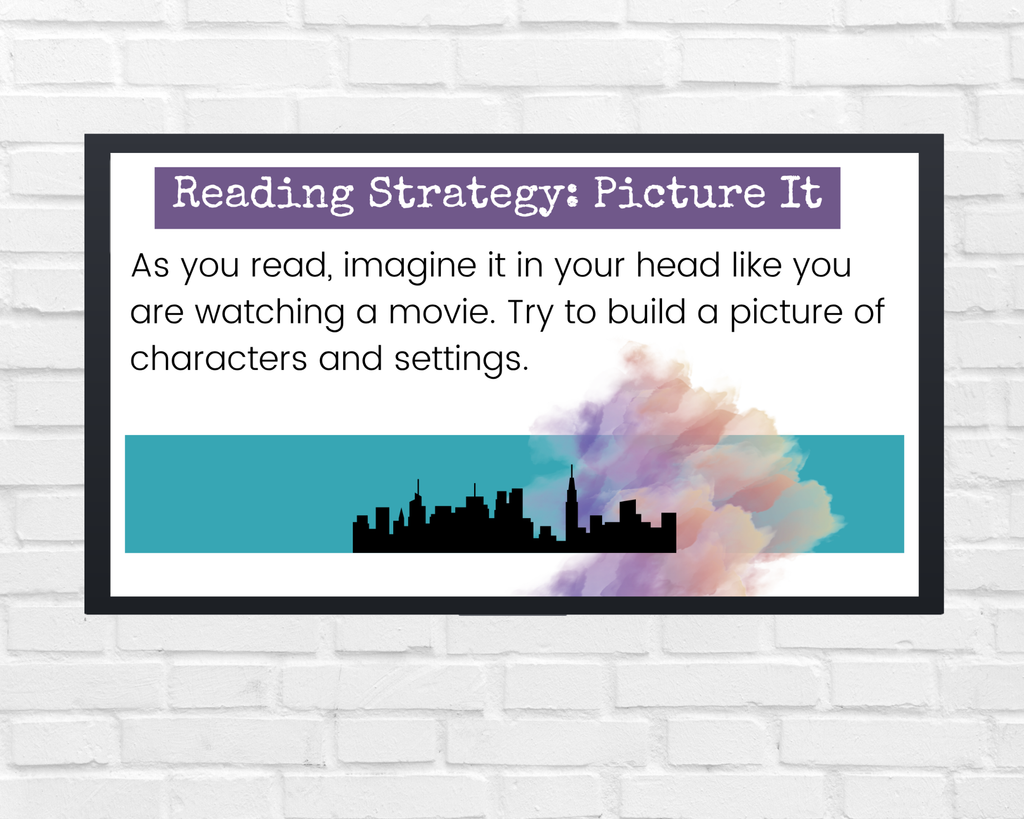
This one is second nature for many readers, and totally new for others. The idea is to build a world of imagination in your head for the book you’re reading. Readers who have ever looked at a book cover and said “That is NOT what Percy Jackson looks like” will understand this one. This strategy is especially helpful at the start of a book, when you’re still trying to figure out where you are, what’s going on, and who’s around.
#2 Ask Yourself
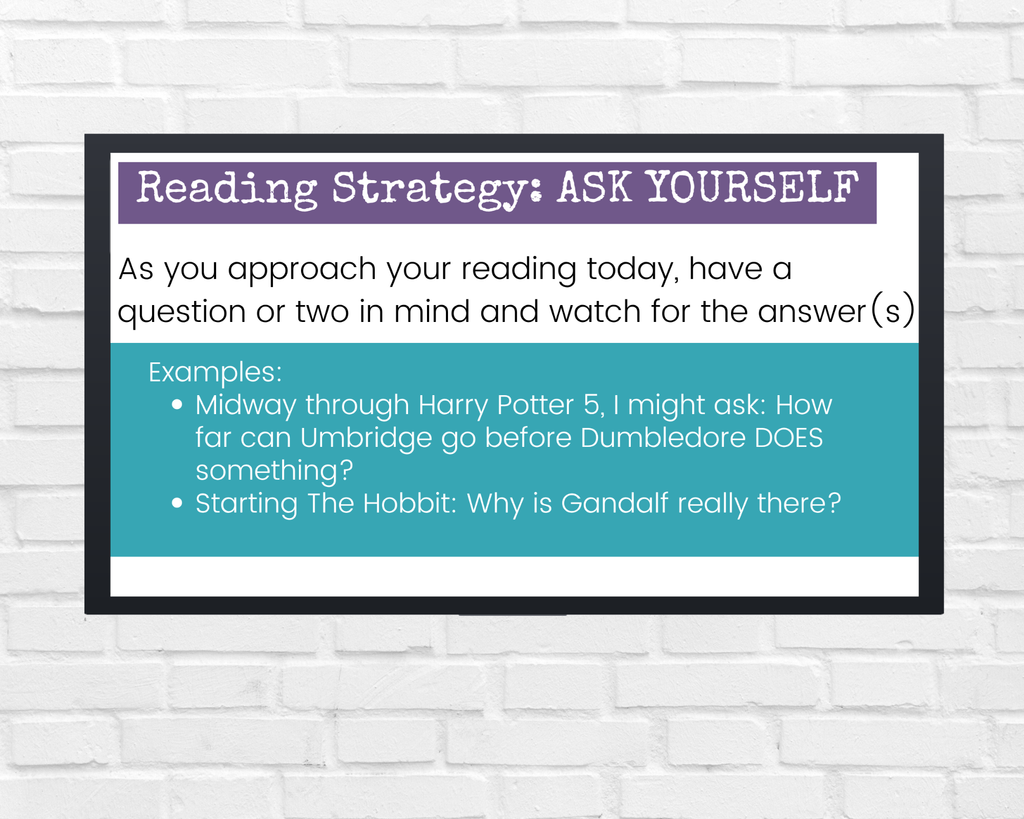
To try this strategy, a reader can hold a question in their mind and search out the answer as they read. Recently I read aloud the first part of Neal Schusterman’s Unwind. There were so many references to unwinding in the first few pages, but no definition. I paused early on and looked around at my class, “One question that’s definitely on my mind right now is, What’s an unwind? What’s unwinding?” A few minutes later, after we had a little more info, I paused again to ask, “Are you starting to form a guess about what unwinding is?” Sure enough, someone had a guess that was, in fact, correct, though we didn’t know it yet as we continued (and I didn’t reveal it!).
#3 Sketch It
You know how I feel about sketchnotes. Tune in to “The Extraordinary Impact of Drawing to Learn” on the Edutopia School of Practice podcast to see some research-based proof of what we already knew, how drawing ideas makes information memorable to students. To try this strategy, students can take a few minutes to draw their vision of a character, a house, a map, a game arena – you name it. If there’s something in their book that’s confusing them and making it harder to follow the story, they can take a few minutes to draw and label it so they’re ready to rock and roll. Penny Kittle suggests one of her students draw the setting of his book in Book Love. I bet you’ve had students make maps of East Egg, West Egg, and the Valley of Ashes if you teach The Great Gatsby. Maybe you’ve done character masks or portraits, body biographies or open minds. These are all ways of helping students see things that are happening in the text, just like the “sketch it” strategy.
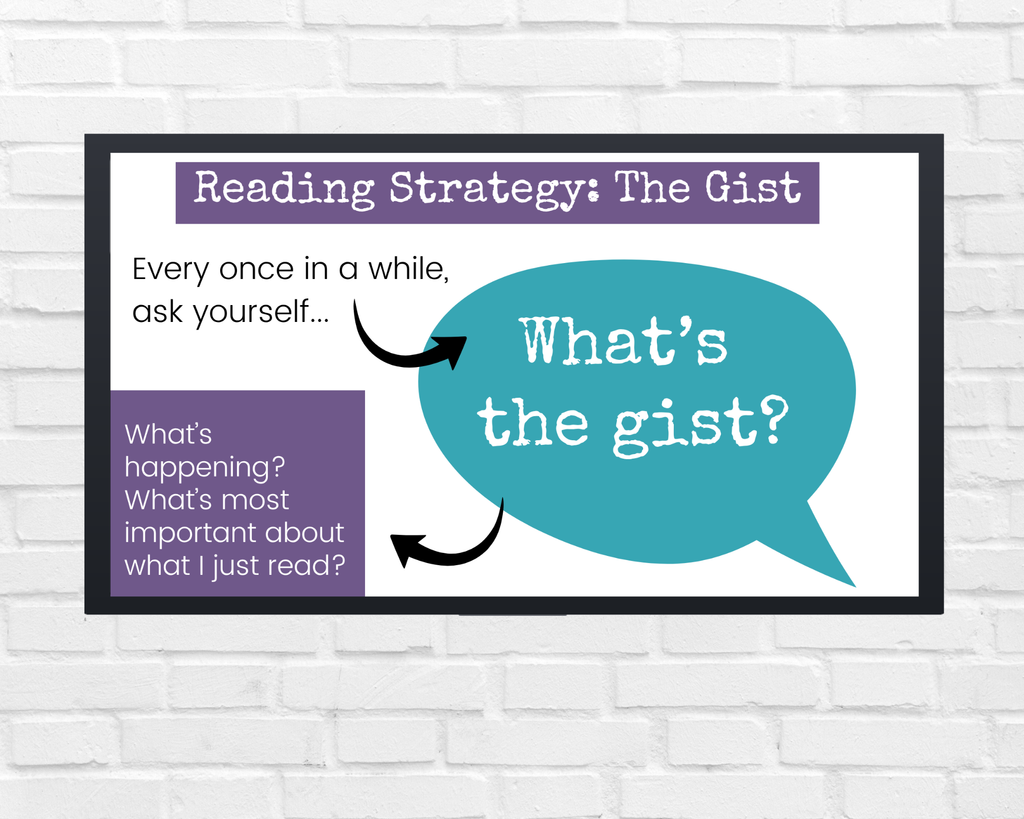
#4 What’s the Gist?
If students are reading a long chunk of text, they might benefit from breaking it up and noticing what’s going on. Every once in a while they can ask themselves, what just happened? How would I explain this to a friend? For example, OK, we just met what seems like the main character and got to see who her friends are. There is a longer “gist statement” strategy for writing summary, originally pioneered by James Cunningham in 1982, that I’ve seen referred to, and this is like a Gist Statement Lite, just a quick mental check-in about what’s going on rather than a longer summary writing strategy.
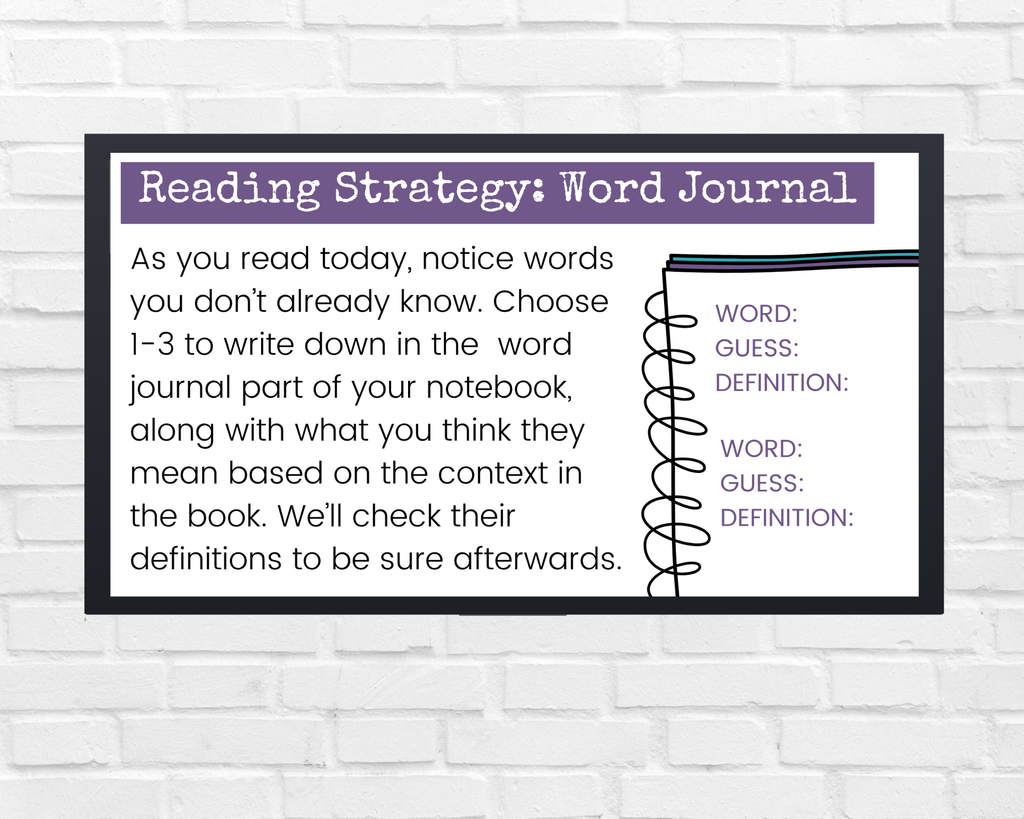
#5 Word Collection
You know the drill – vocabulary is best in context. So how to do that? Well, one option is to scout for great words while reading, and then jot them down. Like so many things in the classroom, everyone is likely going to be new to different words. So if students pull a few words that they’ve never seen, try to guess the word from context clues so they can keep reading, and then define them or break them up into morphemes to define as they file them into a word collection journal or notebook section, then they can build up their own growing word expansion bank. Ted might add “ravenous” and “quixotic” on the same day Marybeth adds “psychosomatic” and “blitz.” This is yet another way we can differentiate.
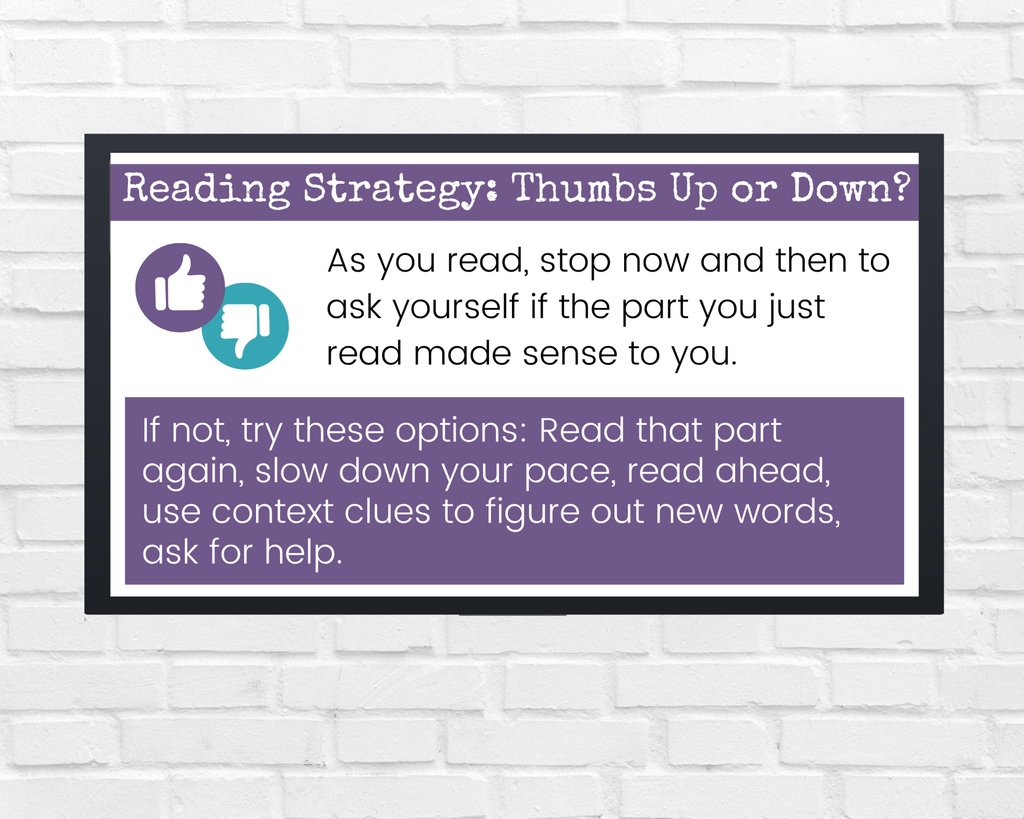
#6 Thumbs Up or Down
Sometimes when I’m reading something very dense, I completely zone out and realize I have no idea what just happened. Oh, you too? Yeah, then as experienced readers we know we need to ask ourselves, wait, what just happened? If we don’t know, we need to go back. This is my simple social media-inspired twist on Shea Kerkhoff’s strategy, “Click or Clunk.” Kids need to know that if they forced themselves through a section and got zilch out of it, there’s still work left to do. Kerkhoff shares many “fix up strategies” like re-reading, slowing down, reading ahead to try to see if there’s a summary, looking for diagrams or illustrations that can help, using context clues to figure out difficult vocabulary or new terms, etc.
Introducing the Strategies
This year my “bellringer” is almost always quiet reading. And every once in a while, I project one of these strategies and give it 60 seconds of attention before getting out of the way of my readers. At this time, I also tend to review past strategies really quickly. So, I might say, “remember if you get into a difficult part today, you can try picturing what’s going on in your mind, re-reading when you feel confused, sketching out a picture of what’s going on” etc. Then I leave whatever the new strategy up on the board as kids are reading. I know some kids don’t need these. But there they are, for those who do. And importantly, it gives us a common language for strategies like these when we’re conferencing about what they’re reading.
Spiraling the Strategies
One way to spiral back to these reading strategies is when checking in with readers in conference during independent reading time. Penny Kittle is my absolute go-to on this. She will ask students something like “have there been any tricky parts? What are you trying to help with those?” I ask my students the same thing if I can see a book is challenging their comprehension. Then I may refer to one of the strategies we’ve learned as an option to help them get through those tricky parts. Of course, the trickiness may call for something else, like a new book or a handy translation tool to help them see what a word means in their own language. But sometimes one of our strategies might be just the thing!
During read alouds I can also spiral back to these strategies, just taking ten seconds to refer to a strategy that comes up for me as I’m reading. Maybe I read a super dense part and then admit I’m not quite sure what happened, and go back and re-read part of it. Or maybe I read a line with a difficult word, and slow down and try to put together a guess for its meaning from the context. I can name these strategies as I do them, to help students notice what’s happening.
Individualizing the Strategies
Reading strategies are yet another area of ELA where differentiation and agency are everything. In the same class, you’ll likely have a vocabulary whiz who only jots down incredibly difficult words in his word journal, an emerging bilingual student who will really benefit from searching for context clues, an artistic student who isn’t that into books but finds some connection via sketching characters, etc. By providing a range of strategies, suggesting them to individuals in conference when they seem helpful, and modeling them yourself, you provide a whole range of rope ladders kids can grab if they’re having trouble with the reading.
Sources:
Kerkhoff, Shea. (2026). Adolescent Literacy: Integrating the Sciences of Reading and Writing in Grades 4-12. Bloomsbury Academic.
Kittle, Penny. (2013). Book Love. Heineman.
Online Supplementary Videos Associated with Kittle, Penny & Kelly Gallagher. (2018). 180 Days: Two Teachers and the Quest to Empower and Engage Adolescents. Heineman.
Leong, Kristin. (Host). (2025, October 28). The Extraordinary Impact of Drawing to Learn. [Audio Podcast Episode]. In Edutopia’s School of Practice Podcast. https://podcasts.apple.com/us/podcast/the-extraordinary-impact-of-drawing-to-learn/id1840474338?i=1000733852674