There are so many ways to grade students. You can avoid zeros, use a standards-based approach, allow iteration, tweak your late policy, experiment with different categories and percentages.
What works best? That’s hard to say. But today’s guest, Dr. Brittany Dillman, wanted to try something different. She’s an expert in educational psychology and educational technology, and directs several online masters programs at Michigan State University. She decided, with her colleagues, to step away from traditional grading and its many remixes altogether, and pursue an alternative known as “ungrading.”
As a student myself in several educational technology courses there, I noticed the ways this approach felt different, and I liked it. So today I’m delighted to welcome Brittany to talk about ungrading – what it is, how it can help students, and how you can try it out in small ways to reap its benefits and learn from your experiments even if you’re not prepared to chuck your digital gradebook.
What is “Ungrading”?
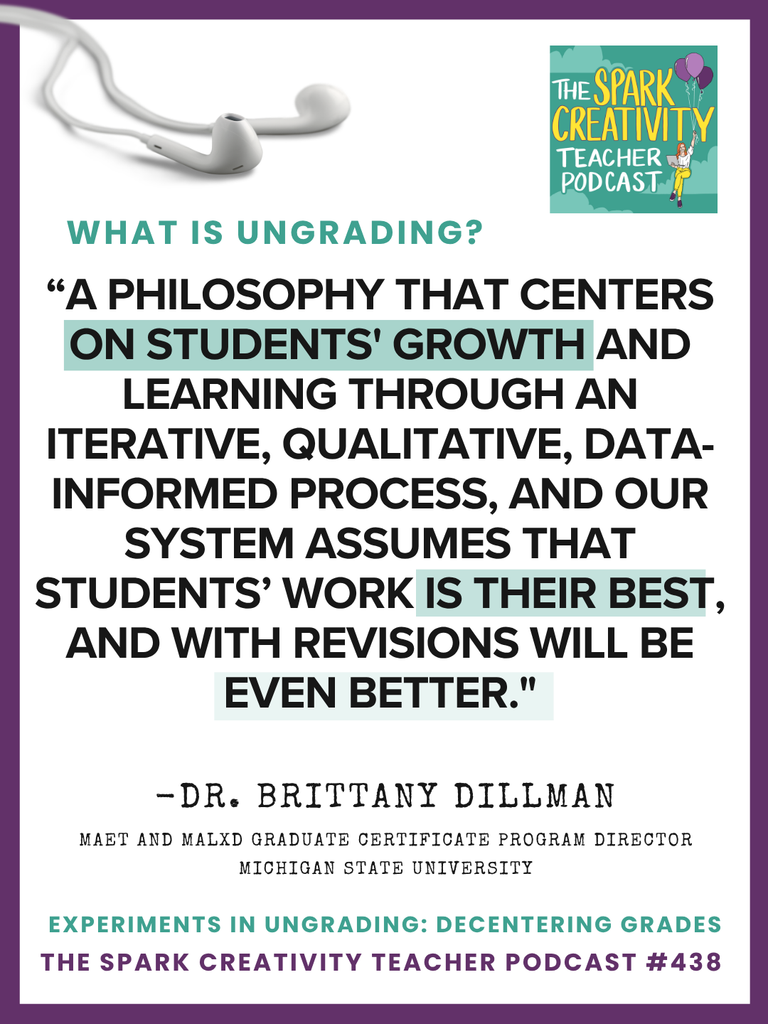
Dr. Brittany Dillman defines the ungrading approach she has helped to pioneer in the MATC and MALXD programs at Michigan State University like this: “a philosophy that centers on students’ growth and learning through an iterative, qualitative, data-informed process… our system assumes that students’ work is their best, and with revisions will be even better.”
From my perspective, as a student who took several grad school classes that were ungraded last year, the philosophy felt like it asked me to do my best work, in my own way, with grades acting neither as threat or reward. Professors were available to me to share materials, answer questions, guide conversations, and help me look at possible expansions of my thinking or new sources. If I wanted to try something, they were generally open to it. The courses I took were highly choice-based, with “artifacts” of learning assigned with clear rubrics. I was a big fan.
Back in 2020, as schools around the country suddenly became interested in online learning approaches, the programs Dr. Dillman and her team worked with were in a position to share their best practices, since they’d been teaching online for many years. But as they talked with others about what works, they also began to reimagine their own assessment practices as the country considered the possibilities in education. They decided to try something new – ungrading.
Brittany is quick to point out that the learners they work with at MSU are adult learners, entirely online, and working in the field of education. So, of course, their version of ungrading is unique to their community and needs. Your context will undoubtedly be somewhat different, but we can all learn from each other’s experiments.
In these programs at MSU, faculty share pre-set rubrics with clear communication in advance of major assignments, and provide specific revision criteria along the way. Students examine materials, share work, receive revision suggestions as needed, and then iterate.
Ungrading does not mean self-paced learning, nor does it assume that everyone will or should get a 4.0 in the course. These are common misconceptions about the practice.
The Benefits of Ungrading
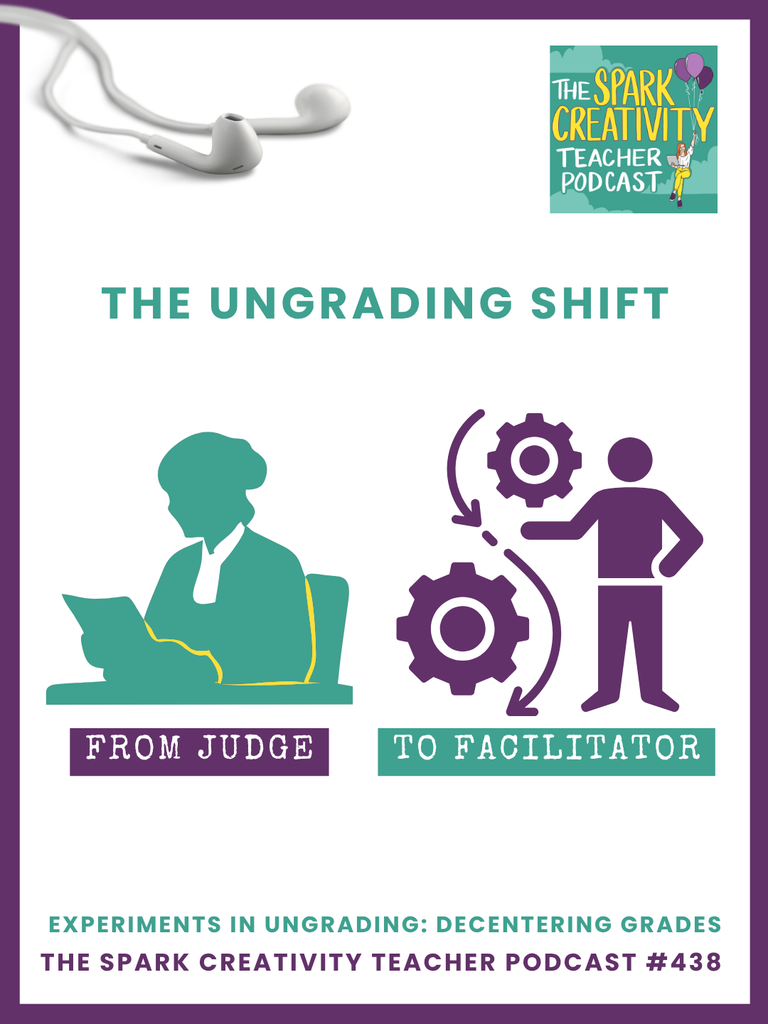
“The coolest strength,” said Brittany, “is the latitude it affords students to take risks and be creative.” Under the ungrading approach, students sometimes aren’t sure if something is going to work when they put it forward, but it almost always does. Brittany has found that it’s easier to shepherd students’ learning when she doesn’t have to worry about taking off points. Whereas before, it felt like she was on team grading/content, almost set up to be “against” the student, the switch to ungrading helped her to feel like she was on team student/content – a lovely switch, like going from judge to facilitator.
In general, she thinks students feel more supported by instructors, and she’s glad to skip the conversations she used to have with students about why they lost points over something (a sentiment we can likely all relate to!).
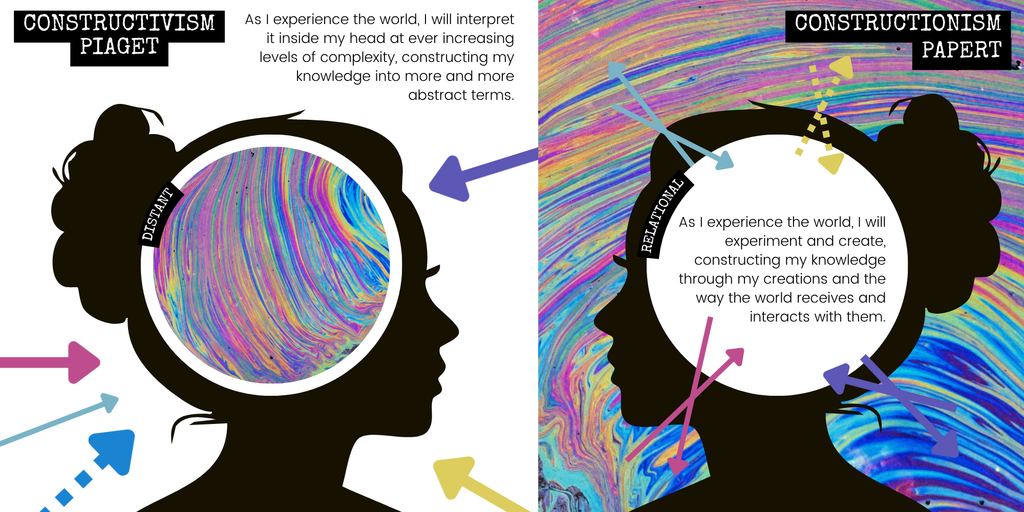
Ungrading empowers students with more choice. They’re more able to innovate without having to guess what their instructor is looking for. They’re also able to build on their own knowledge, moving forward in the location in their learning arc where they are. Brittany connects this idea to constructivism, Piaget’s concept that everyone builds their knowledge based on what they already know, interpreting ideas into more abstract terms over time.
As she puts it, “phenomenal growth” is what they’re looking for in the program. Everyone may start in a different place, but everyone can travel far in their learning. Again, as a student myself in several ungrading courses, I felt this to be true. While I came into the program with extensive experience in the education field, I always felt I could choose to study what was meaningful to me, what would take me further. I could create, essentially, whatever I wanted/needed to create to push my work in the subject of the course, which I loved. While the rubrics were highly specific, they were also extremely flexible to different kinds of possible work.
In Brittany’s experience, two themes emerge when talking about the benefits of ungrading: relationships and creativity. If we think about a loop of agency for students, there’s the option to give them agency over where to focus for content and how to showcase their learning, and ungrading completes the loop by not having judgment at the end based on teacher expectation of what they “should” learn and create. Students can get support from their professors without feeling judged by them.
The Challenges of Ungrading
A few major challenges emerge from the ungrading philosophy:
- Students sometimes feel like they’re not doing enough. To mitigate this issue, Brittany’s programs at MSU offer students the chance to ask, early, for an example of the grade a professor might have given a piece of work alongside their revisions, just to give a sense in familiar terms. But fewer students have requested this as the program has become established.
- For a few rare students, it’s difficult to know what to do when they simply fall off the radar, not doing the work, not communicating about the work.
- The course model in which a huge project at the end is the culmination of learning does not work. Professors need to offer the opportunity to check in and iterate prior to course closing, so there isn’t a big surprise if a student does poorly without time for further revision.
And, perhaps most relevant for this conversation, ungrading does *not* lead to less work.
If you’re dealing with huge class sizes, seven preps, etc. it would be very difficult to coordinate this system. Brittany describes a hidden spreadsheet behind the scenes to track logistics – the assignments, the revisions, the completion of all the steps for every student. Organization and clear, detailed rubrics are key elements to success. The programs she runs use single point rubrics, with professors providing steps to the student in their feedback about what needs to happen for the revision process. Students then make revisions and resubmit or tag professors with comments showing their revision on digital assignments.
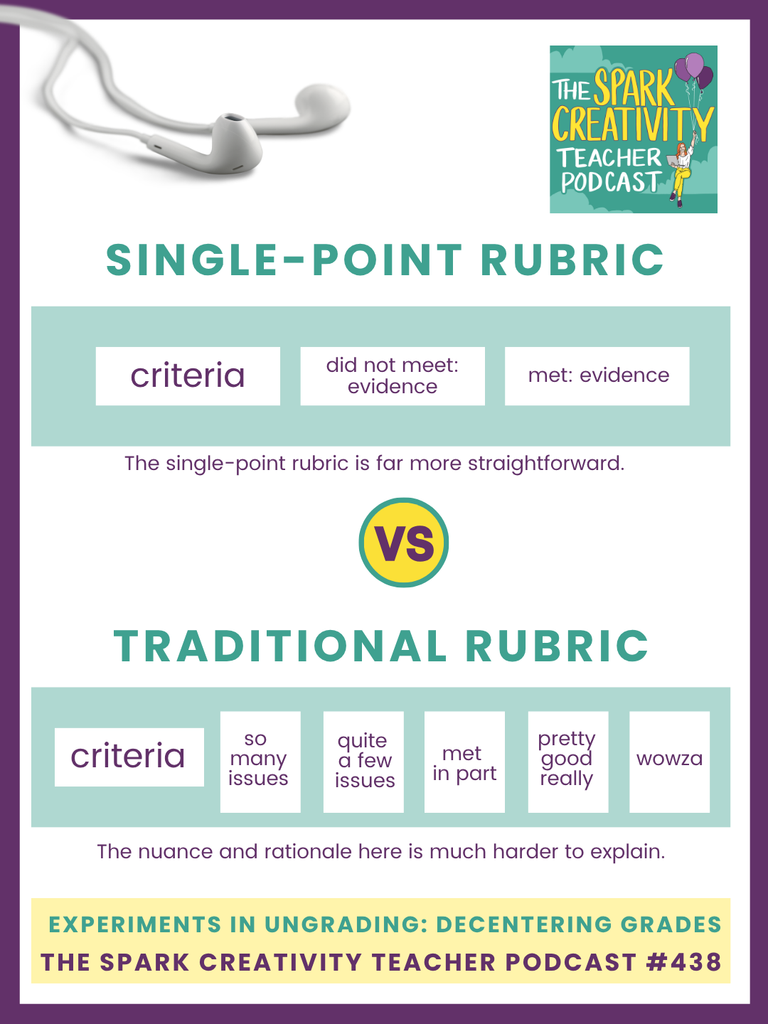
When Brittany and her team decided to move toward ungrading, nobody was against it. Which says a lot, if you think about it. It’s a lot of work to organize, and yet the benefits are substantial. As new professors rotate into the program, it’s all about helping people with logistics and workflow, not convincing them that it’s worth it.
An Unanswered Question: How to Defend a Final Grade if you Have to Give One
For students at MSU in these programs, a final term grade is still required, because MSU at large does not practice ungrading. If you’d be in the same boat at your school, Brittany suggests that it’s essential to let students know as soon as it is clear that work is not being completed, or that they are not meeting expectations, and that means dropping the grade. Don’t count on maybe, she says, “clear is kind.” She also underlines that clear, focused rubrics in alignment with backwards design of material is essential.
In the end, she doesn’t have a solution to the likely problem of parents saying “why?” or “that’s unfair.” Since she is working in an adult learning context, that’s outside her realm of work right now. The ungrading philosophy is, in some ways, emerging practice. But in other ways, it’s ancient. As Brittany points out, grades are a relatively recent thing. Even now, many students do significant learning in their early years of education with no need for grades. Elementary school is often structured in a more mastery-based approach.
Taking Steps toward Decentering Grades
So what if you’re feeling intrigued, but not ready to throw out your gradebook altogether?
“Any change,” says Brittany, “starts with very small actions.” She invites us to consider, “What is one thing you could not grade?” Maybe that’s one thing in the first month, the first term, or the first year of experimenting with this approach. Maybe you try reading outlines and drafts and not grading them, but instead presenting back themes you noticed in the work and asking students to search for those in their work and improve them. Maybe it’s something else.
Having conversations with colleagues is also a great step. These initial conversations helped the team in these two departments at MSU unearth their beliefs about assessment, and it might do the same for your department.
Go Further with Ungrading & Connect with Dr. Brittany Dillman
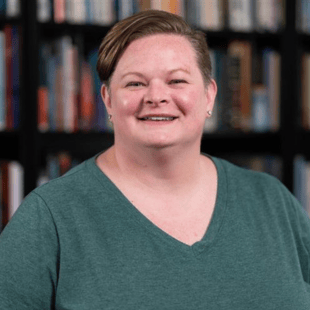
Dr. Brittany Dillman joyfully works with a phenomenal team of educators for a wonderful group of students who are part of the Master of Arts in Educational Technology (MAET) or Master of Arts in Learning Experience Design (MALXD) programs in Michigan State University’s College of Education. Brittany regularly teaches courses about educational psychology, educational technology, mathematics teaching and learning, assessment, and design. Brittany oversees the curriculum and course content for 17 courses and supports the 25 instructors who teach those courses each year. Brittany loves spreadsheets, efficiency, and talking about teaching and learning. Brittany has a background in teaching middle school mathematics and loves to travel with her family.
You can reach Dr. Brittany Dillman by Email: dillmanb@msu.edu
You can read this work by Jesse Stommel that inspired her team’s work at MSU:
You can learn more about the two programs Dr. Dillman leads:
The MAET Program: https://education.msu.edu/cepse/maet
The MALXD Program: https://education.msu.edu/cepse/malxd