Recently I listened to Daniel Wilingham’s book, Why Don’t Kids Like School?, about how we can use what we know about how the mind works to make school work better for kids.
And I found myself nodding along in chapter two as he talked about reading: “Do whatever you can to get kids to read, but it’s not enough. People sometimes ask whether graphic novels count, or whether audiobooks do. The answer is an emphatic yes.” I couldn’t agree with Wilingham more.
Sure, I’ve heard the argument that students need “rigor” at school. The canon. The classics.
But I would certainly side with Penny Kittle and repeat the mic-drop line from her book, Book Love: “A book isn’t rigorous if students aren’t reading it.”
Sure, we can give kids only Dickens, Austen, and Hawthorne. That’s an option. We can say only print-reading is “real” reading. But what will we gain, and what will we lose? It seems pretty obvious to me that while a few more kids might read classics if they’re the only option, what will mostly happen is that we’ll lose the majority of kids who might have started to love reading in our classrooms, given different starting points.
So today I want to share the graphic novels I’ll be showcasing in my classroom library this year. I’m really happy with this collection for my high school students, and I hope you’ll find some new options for your library as I share mine. Of course, as always, you know your community best.
Quick Intro: The Power of Choice
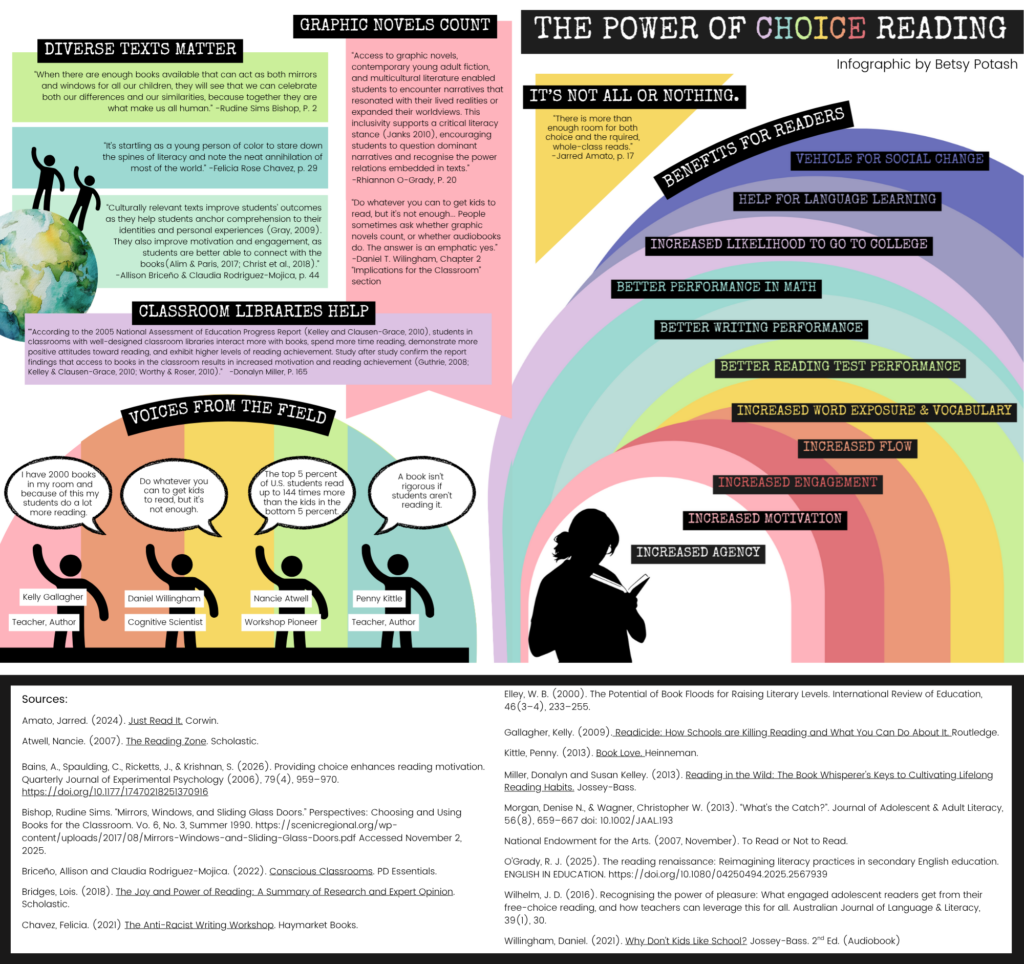
Just in case you bump into trouble as you build your choice reading program, including your classroom library collection and your graphic novels, I wanted to share this infographic I created based on my research into the benefits of choice reading. You can dig in further in my previous post/pod, The Uncrackable Justification for Choice Reading.
For a graphic-novel specific argument, check out Gene Luen Yang’s fun, funny, and persuasive Ted Talk, Comics Belong in the Classroom.
16 Graphic Novels for your High School Classroom Library
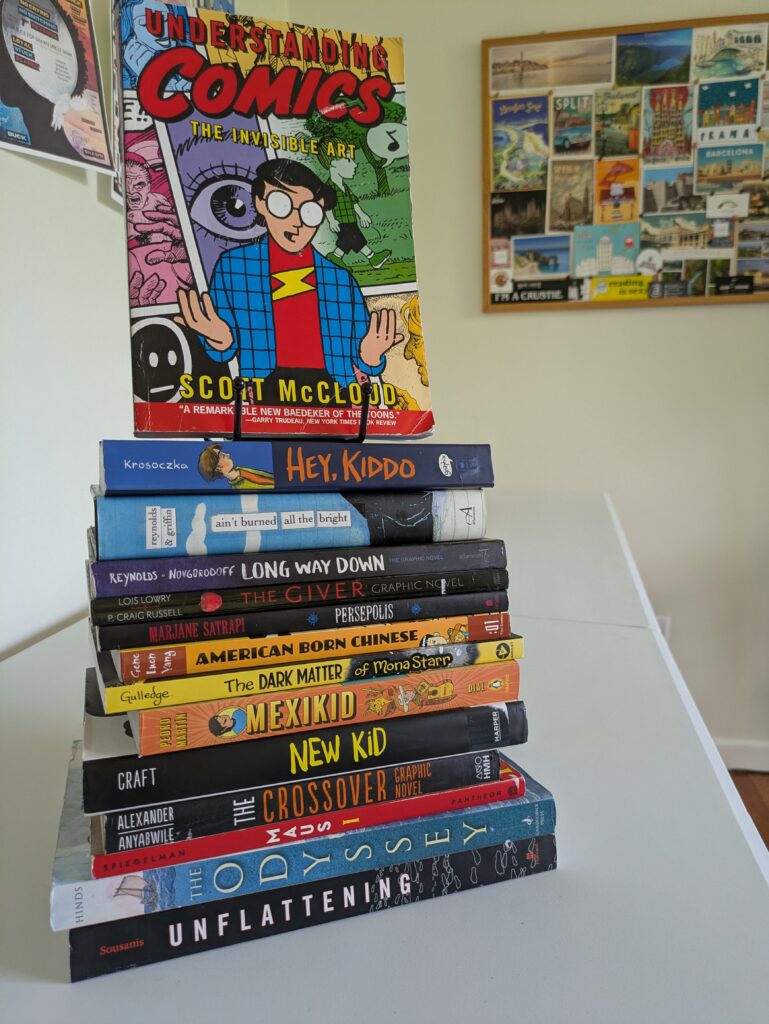
Graphic Novels about how Graphic Novels Work
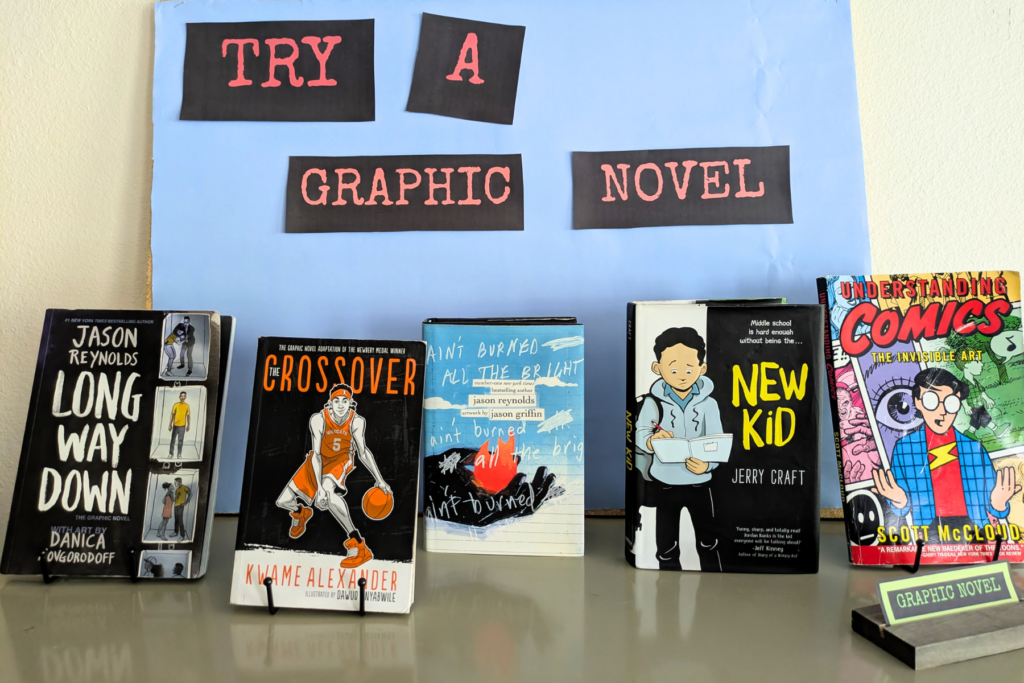
Let’s start with two amazing graphic texts that are ABOUT graphic communication: Unflattening and Understanding Comics. I’ve got these for the kids who really go deep with graphic novels, and because I will use them as resources when we’re reading Romeo and Juliet in both text and graphic novel form.
McCloud’s Understanding Comics is a strong tool for learning the techniques underlying the creation of a graphic story. And Sousanis’s Unflattening takes it to the next level. The book stemmed from his doctoral thesis on graphic communication, told through his own graphic communication.
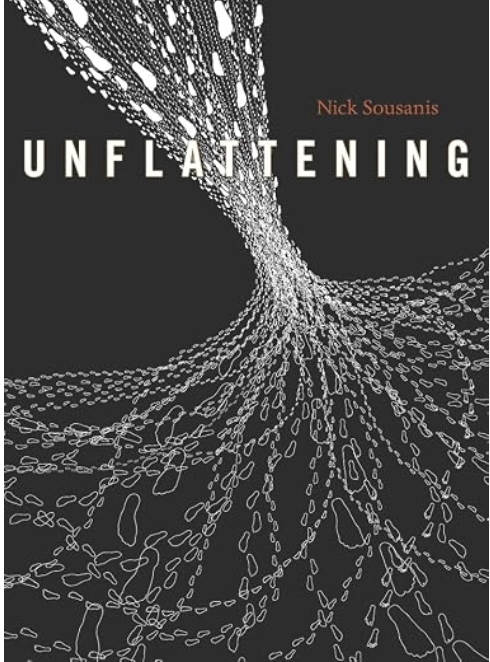
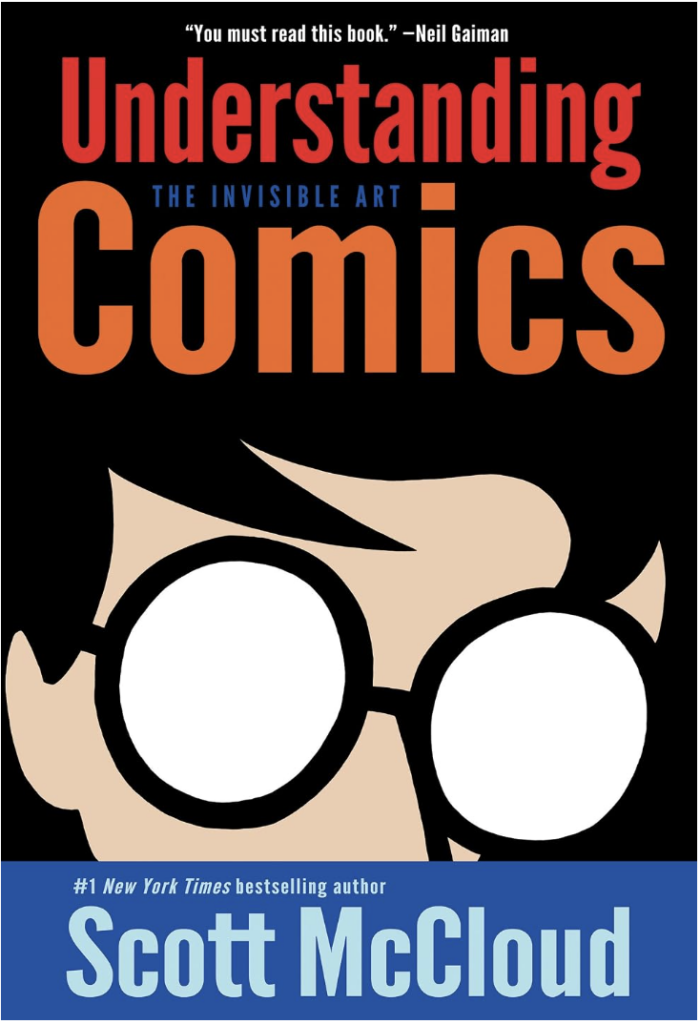
Book Cover Screenshots from Amazon
Memoirs
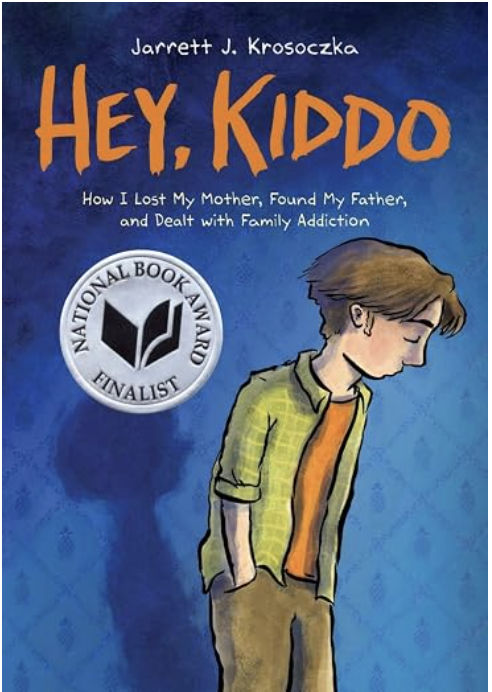
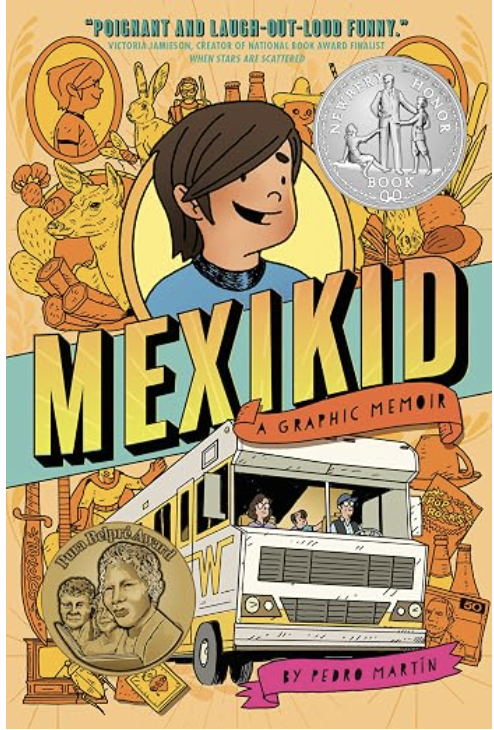
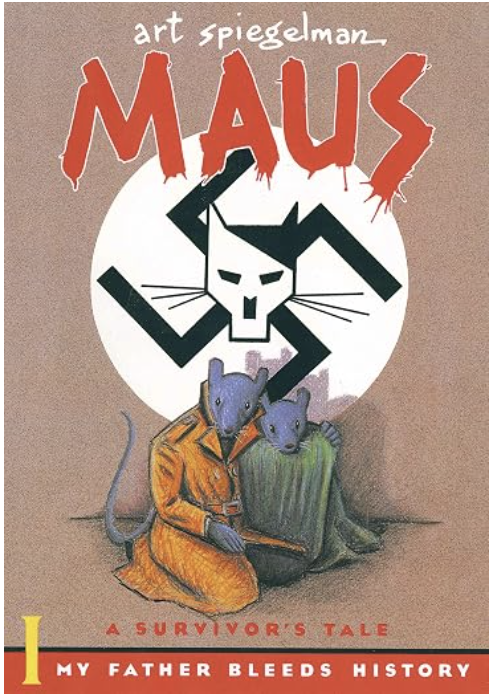
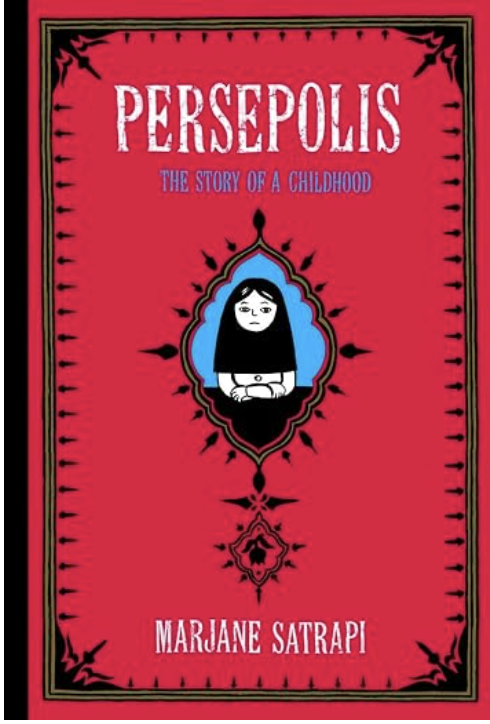
Many strong graphic texts are actually graphic memoirs or stories of someone’s life. (But that word – graphic – can cause us some trouble here). You know what I mean. Maus, Persepolis, Mexikid, and Hey, Kiddo are all examples of authors looking back on their lives or, in the case of Maus, a family member’s.
Maus (a Pulitzer-Prize winning book) is the story of the author’s father’s experience during the holocaust, surviving a concentration camp. Persepolis looks back at a childhood experienced during the revolution in Iran. In Mexikid (a Newberry honor book, and winner of the Pura Belpré award), the narrator remembers a road trip with his family to Mexico in middle school with many funny adventures along the way. And in Hey, Kiddo (a National Book Award Finalist), Jarrett Krosoczka looks back on his experience trying to understand his situation as a child when his father was gone and his mother was addicted to drugs.
Book Cover Screenshots from Amazon
Text First Graphic Adaptations
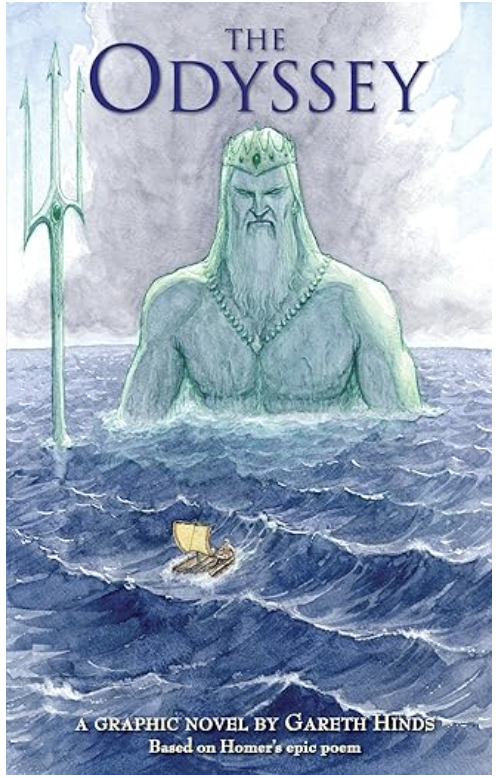
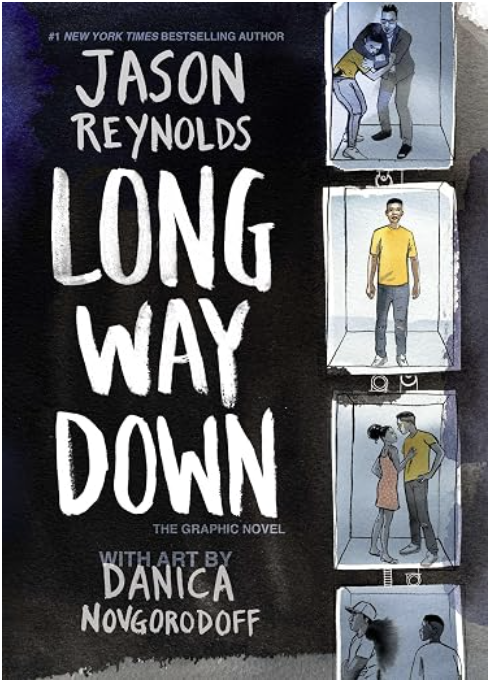
These books are new gateways to great stories that already exist in print form. I’ll have The Odyssey in text and graphic novel form in my library (curious about this pairing? Check out this interview with Gareth Hinds, the creator), and same for Long Way Down. In fact, my class will read Long Way Down as a novel-in-verse as part of our curriculum, and we’ll look at Jason Reynolds’ collaboration with Danica Novgorodoff as part of our unit (check out the lesson in this post).
Book Cover Screenshots from Amazon
A Graphic Novel focused on Mental Health
If you heard my interview with its author, Laura Lee Gulledge, you already know I love The Dark Matter of Mona Starr. Laura Lee generously shared a lot of wonderful activities to go along with it, if you’re using it as part of a graphic novel unit or graphic novel book clubs. But it’s also a winner, in my view, for your library. Mona encounters depression, which she terms her “dark matter” and searches for ways to get through it with help from a counsellor, her parents, and her friends throughout this stunningly-illustrated book. I always like to see representation of mental health matters in youth literature, and this book effortlessly showcases strategies for coping with depression.
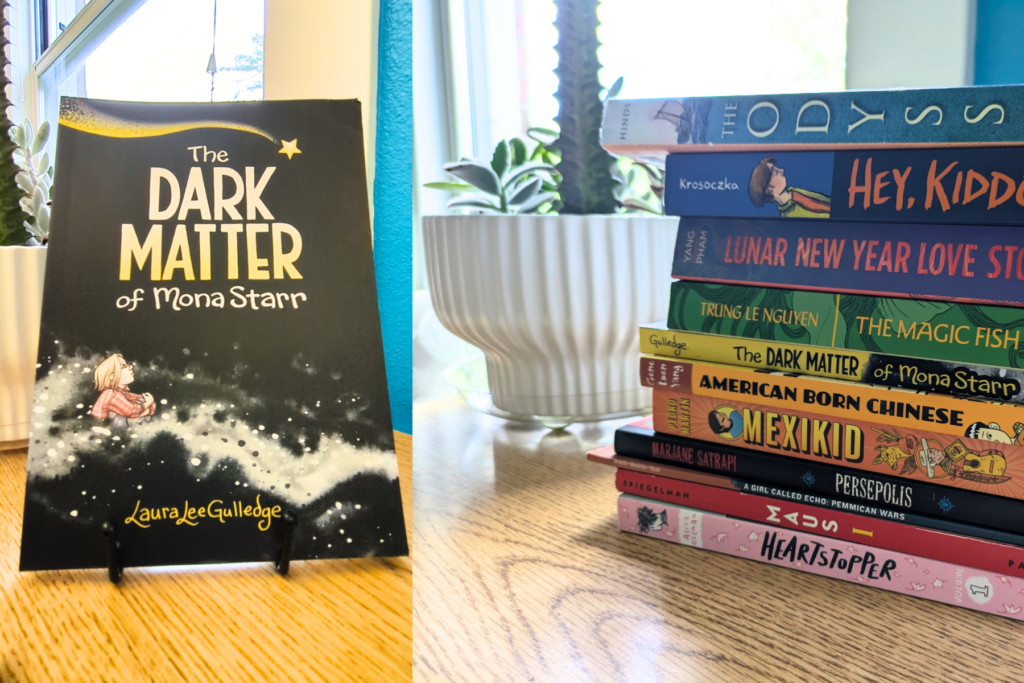
New-to-Me Finds
This summer I read several new-to-me graphic novels to help expand my collection. I already know and love Gene Luen Yang, and had ordered American Born Chinese (now a series on Disney!) for my library, but was pleased to discover his collaboration with Leuyen Pham, Lunar New Year Love Story. I also remembered another teacher recommending The Magic Fish years ago in Camp Creative during our graphic novel summer, and decided to buy and read it.
Lunar New Year Love Story is a a teenage love story with many twists. The main character loves Valentine’s Day and believes in true love until her faith is rattled by an unexpected revelation about her parents. She seeks joy and love (but wonders if it’s really possible to find it) as she joins a dragon dancing studio and takes a trip to Rome, finally finding the (spoiler alert) happy ending a book with this cover art and title seem to suggest. And yet the book is not overly predictable, with some really great characters and an intertwining theme about how social media compares with real life.
The Magic Fish is really unlike anything I’ve ever read, which is quite a recommendation already. The main character is not sure how to come out to his parents, as he cannot really explain his experiences in Vietnamese, and they won’t understand in English. He also sees evidence of prejudice all around him, as a radio story about Matthew Shephard plays in one panel, and the priest at his school tries to “counsel” him out of his feelings. His feelings, his mother’s, and his mother’s aunt’s when she travels to Vietnam, become interwoven with the fairy tales they tell and read. These fairy tales are told in different colors than his story, and with striking original art. I love the hope with which this book wraps up, and the winding road that takes us there.
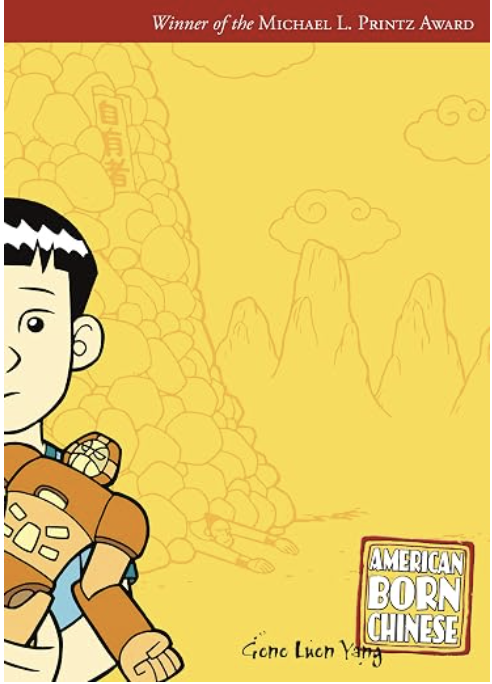
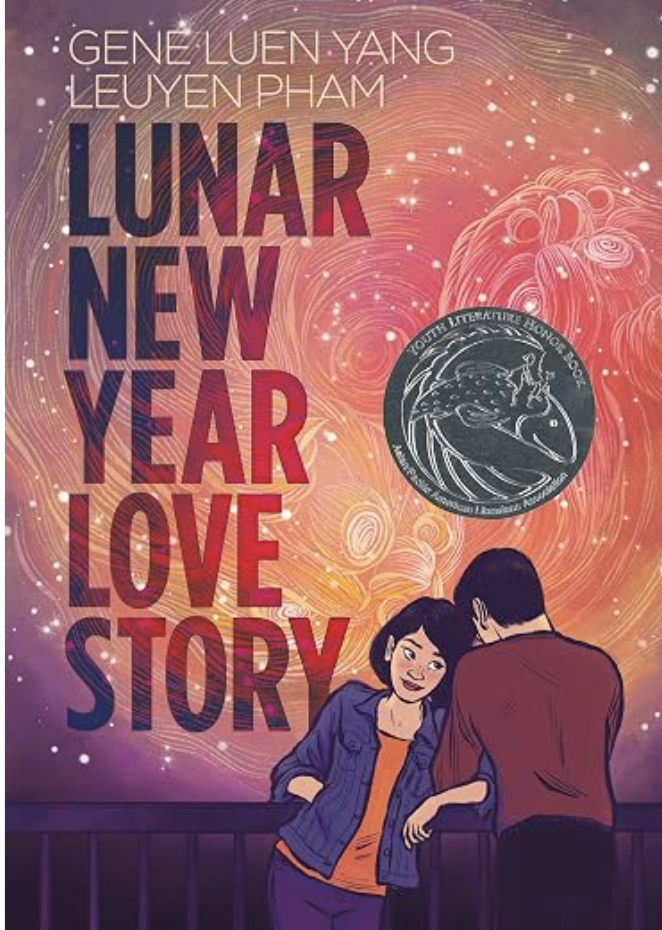
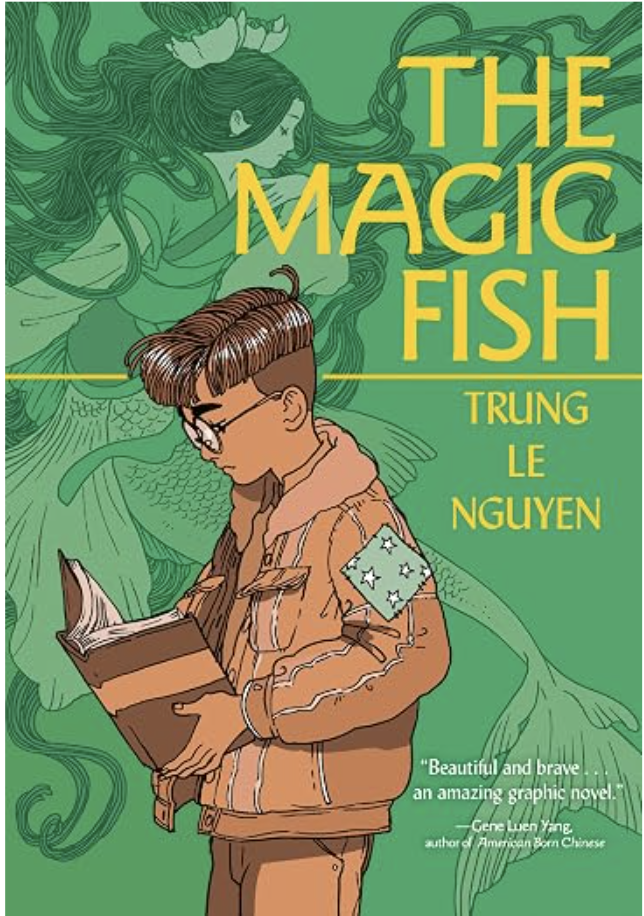
Book Cover Screenshots from Amazon
The Display makes Itself
Graphic novels have such striking covers, they make for an easy display option in your classroom! Plus, they’re a marvelous hook for students who may be wary of your choice reading program as you unroll it. I’m starting the year with graphic novels at the heart of my library, because I want to make it easy for kids who haven’t read a book in years to dip their toes in my library and realize it’s not as boring/horrible/overwhelming/awful (insert the words you’re hearing here) as they think.