
You know how I love to share a great find, and this week I’ve got a real winner for your vocabulary program. On this episode of “Highly Recommended,” I’ll tell you about a new tool I just found and why it’s so high impact for helping kids learn new words. Let’s dive in.
You may already know how helpful it is to teach vocabulary in context, something that was NOT clear to me when I first started teaching and was handed Hot Words for the SAT and directed to cover its contents.
But part of tackling words in context (and not with weekly unrelated word lists and matching vocab quizzes) means figuring out how to help kids break down a word they’re unfamiliar with. In this way, you give them tools to figure out any word, teaching them a language of word parts that fit together to help them understand thousands of words. Looking for context clues when you hit a new word is a great start, and can sometimes get the job fully done, but there’s another ace in the hole that can help kids break down and understand unfamiliar vocabulary when they encounter it.
What am I talking about? Gaining an understanding of prefixes, suffixes, base words, and Latin/Greek word roots.
For example, imagine students have come across the word “comportment” and you want to help them figure out what it means. You can break it down into pieces, helping them figure out how com, port, and ment function.
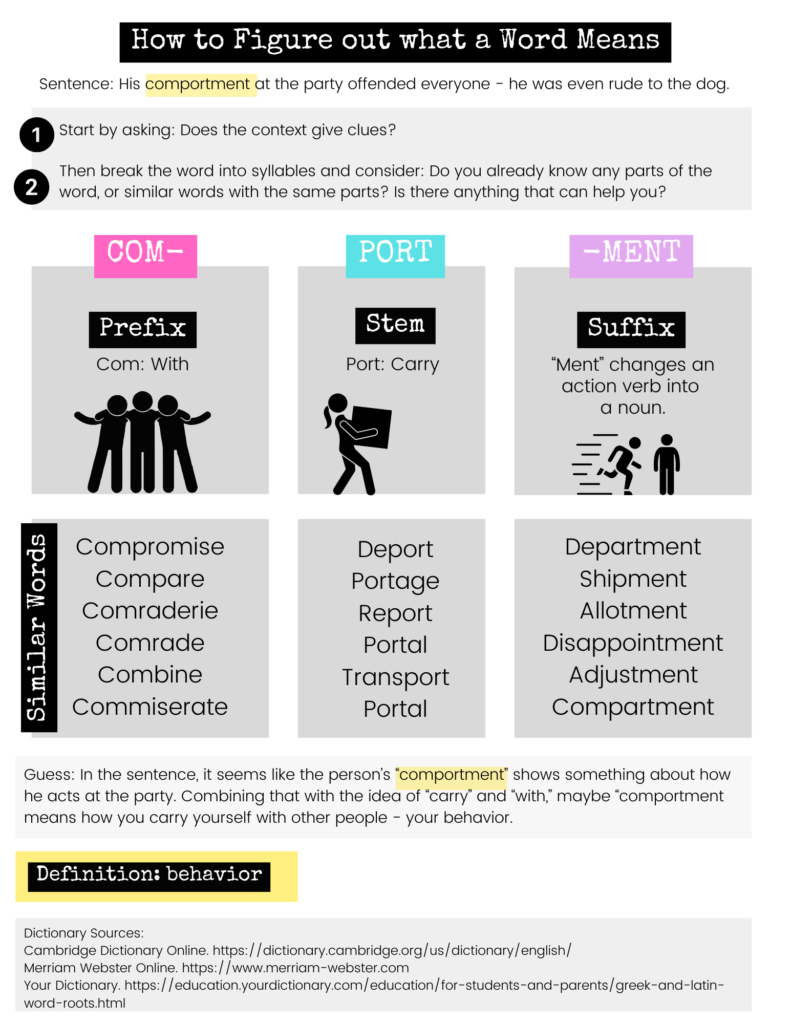
By learning a part, like that “com” means “with,” you’re also giving them a tool to figure out a ton of other words in the future, like compromise, camaraderie, compare, and commiserate. When a new word comes up, you can look at context AND break it down, figuring out the meaning of its parts and talking about words with similar parts that will now be easier to understand.
Total win.
But here’s the rub.
Maybe, like me, your knowledge of word bases, prefixes, suffixes, and Greek and Latin roots is somewhat hit or miss.
Personally, I’ve got a big vocabulary from a lifetime of reading, but if you had asked me to tell you what the suffix “ment” does before I created the handout up above, I would have struggled a bit as I tried to figure it out. You may not be able to slice-and-dice every new word into its parts on the fly for your students. Which is pretty understandable.
Which brings me to today’s amazing highly recommended tool.
This summer I discovered a site to help with this word breakdown process whenever you need it in class. It can allow you AND your students the option to quickly and easily break down a word into its parts anytime, anywhere.
It’s called the “Word Dissector App, ” and it’s from the Iowa Reading Research Center’s Morpheme Lab. The lab in general is great to know about, but this resource in particular is my favorite.
Click here to go explore the tool.
This browser-based app allows anyone to drop a word in, then see it broken down into parts. The app will process the word into a series of word part digital cards. The viewer (you, your students) can then click any card to see it flip to its meaning side.
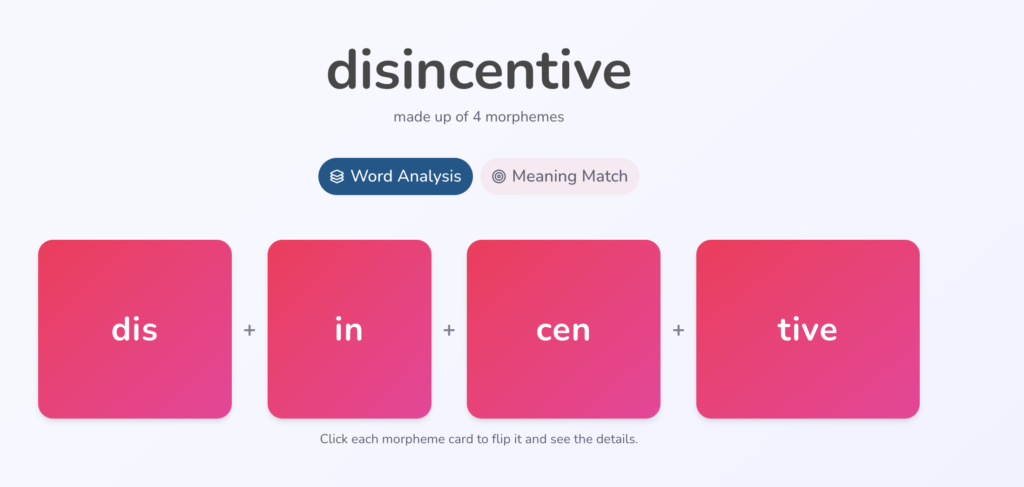
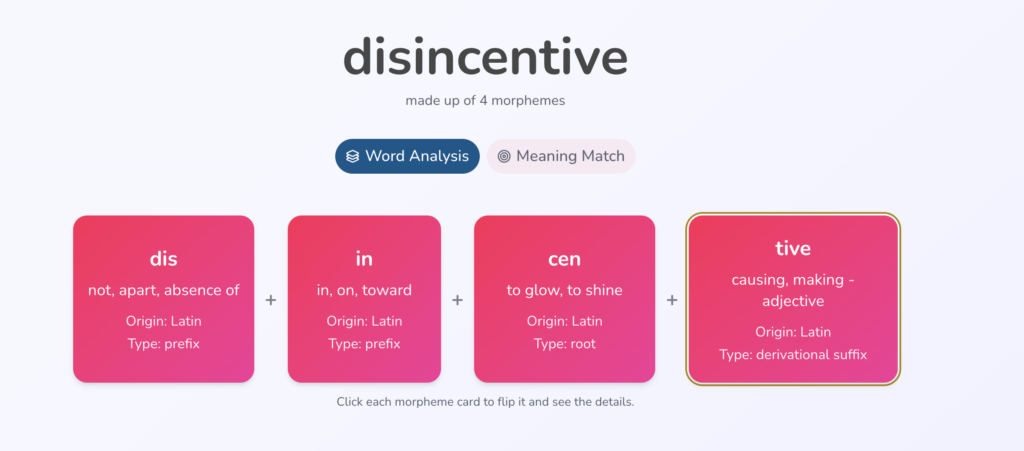
Screenshots from the Iowa Reading Research Center’s Word Dissector App
You can also choose “meaning match” and then play a game, attempting to connect each part in the word with each meaning card, gamifying the learning process and allowing students to see if they already know more than they thought when they first started looking up the word. Context and parallel word knowledge just might allow them to make some matches they didn’t know they knew.
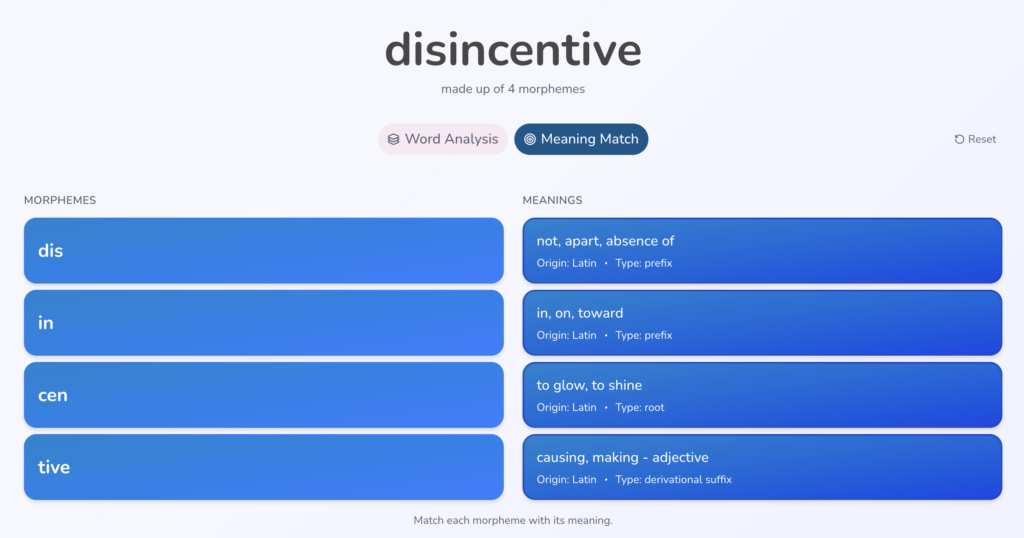
Screenshots from the Iowa Reading Research Center’s Word Dissector App
I’m planning to have this app ready and waiting consistently this year in class, and to guide students toward using it on their own too. It’s a huge shortcut for learning word parts on the fly, as you encounter new words in class.
Sources:
Cambridge Dictionary Online. https://dictionary.cambridge.org/us/dictionary/english/
Kerkhoff, Shea. (2026). Adolescent Literacy: Integrating the Sciences of Reading and Writing in Grades 4-12. Bloomsbury Academic.
Merriam Webster Online. https://www.merriam-webster.com
“Word Dissector.” (2026). Iowa Reading Research Center Morpheme Lab. https://word-dissector.irrc-tools.org/
Your Dictionary. https://education.yourdictionary.com/education/for-students-and-parents/greek-and-latin-word-roots.html