It’s easy to think of hexagonal thinking as a one-and-done. But it’s not. It’s a strategy you can tailor to a thousand different situations. Andi Jackson, veteran teacher, creative thinker, and hexagonal thinking launcher-extraordinaire, is here today to spotlight the possibilities. She’s taken hexagonal thinking, originally developed by Anthony Hodgson in the business world, and remixed it in three different creative ways to help guide her students through complex thinking toward original writing. She’s about to share her stories and tips with us, and I’m positive you’ll come away from today’s episode with fresh ideas for your own use of this fun discussion strategy.
Round One: Hexagonal Thinking for Theme Analysis with The Outsiders
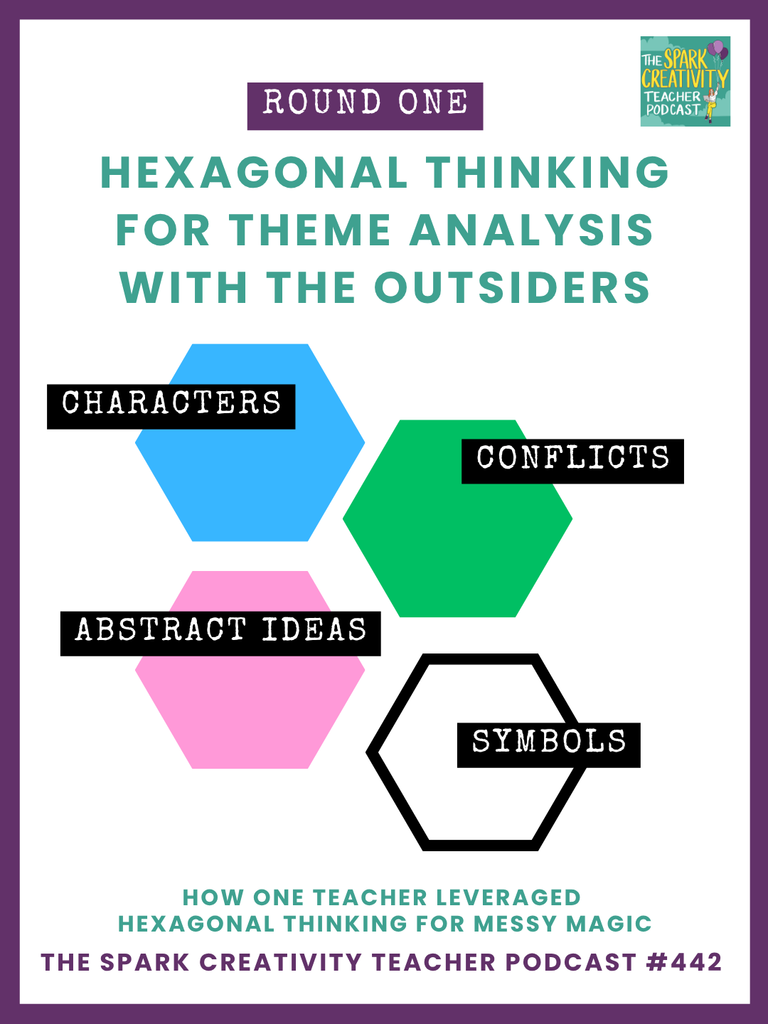
As Andi approached her first round of hexagonal thinking, her students were reading S.E. Hinton’s The Outsiders. She wanted to use this novel as a vehicle to teach her students about theme, often a challenging concept. She decided to use hexagonal thinking as a vehicle to guide them in organizing their understanding of the text and synthesizing key characters and conflicts into the kinds of big ideas that can lead to identifying and understanding themes.
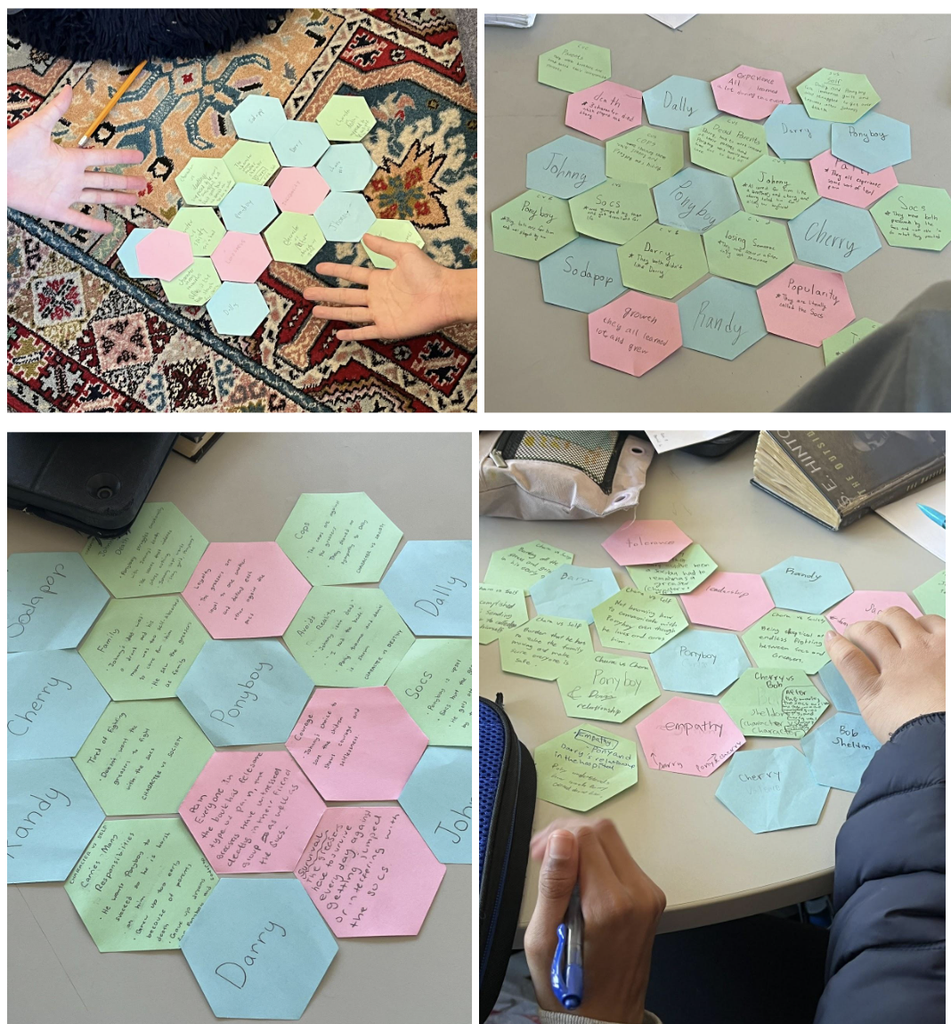
She had about two weeks for them to do the big thinking leading into writing an essay about themes in the novel. So she invited them to work with a partner ( Andi’s classroom premise is “We Get Smarter Together” so they always can work with a partner if they wish) and begin filling in colorful hexagons with key elements from the novel.
The started with blue hexagons, for the key characters. Soon after they discussed different types of conflicts, such as self vs. self, self vs. society, etc.). Then they used this new widening understanding of how conflict works to create green hexagons for conflicts they could identify.
Now they had two types of hexagons to work with, and they begin to make clusters featuring characters and conflicts, taking pictures as they went to document their evolving ideas about the novel.
Next, Andi introduced the idea of characterization, talking with them about the ways a character can grow, change, and evolve over time. This brought up new conversations around the hexagon clusters – how did a character show up before a conflict, during a conflict, after a conflict? Did the conflict cause them to grow or develop? Andi reminded her kids that there was no way to be wrong here, and they spent several days working all over the floor of the classroom, discussing characters and conflicts.
Next came a challenge. She asked them to create a new color of hexagons, pink, for abstract nouns that could help bind the character and conflict clusters, and help them move toward themes. This turned out to be a big challenge, and Andi found they needed a reframe. They shifted over to talking about symbolism and added a layer of purple hexagons to represent key symbols.
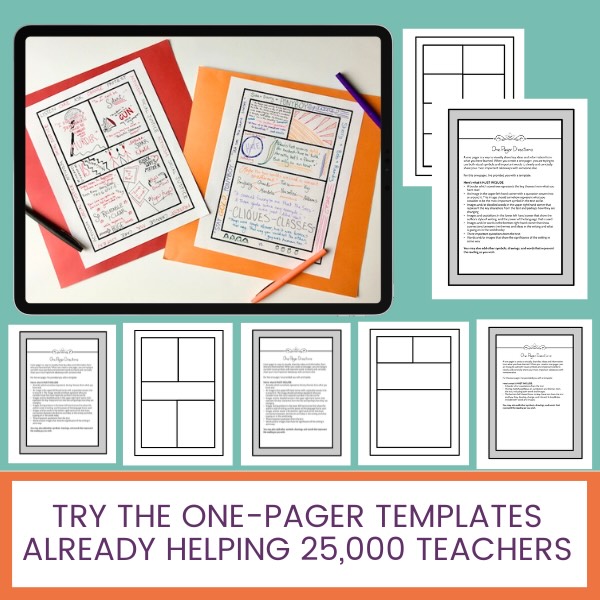
She wanted to help them move from their big conversations and the thinking stretched across their hexagonal webs and move intentionally, now, into defining key themes. So she decided to add another scaffold – a theme one-pager.
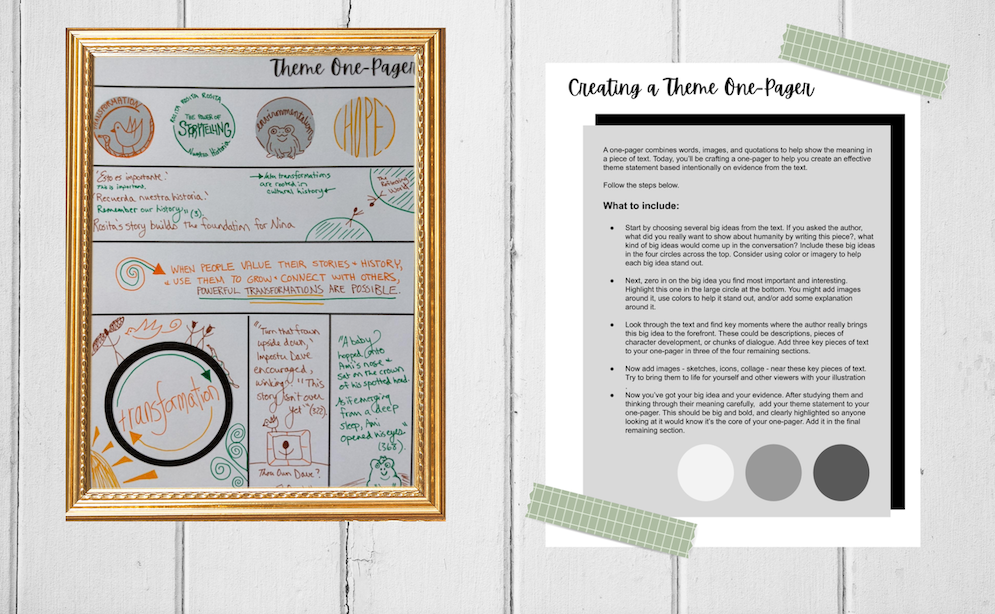
This example of a theme one-pager comes from A Snake Falls to Earth. It’s included to give you a sense for how a theme one-pager might work.
Now the kids transferred their deep thinking from the hexagonal framework into the theme one-pager format to come up with a final theme statement that they could write about. Now they were ready to write their essays.
“It was messy,” said Andy. “But it was amazing.” Rather than give her kids specific options, lists, and formulas for their writing, she gave them opportunities to go deep with hexagonal thinking and theme one-pagers, and then invited them to create meaning from that process in their writing.
Students had the opportunity to engage in real productive struggle throughout this time together, and to gain the self-efficacy that comes from doing something difficult that works in the end.
Round Two: Hexagonal Thinking for Organizing Argument in the “Messy Middle”
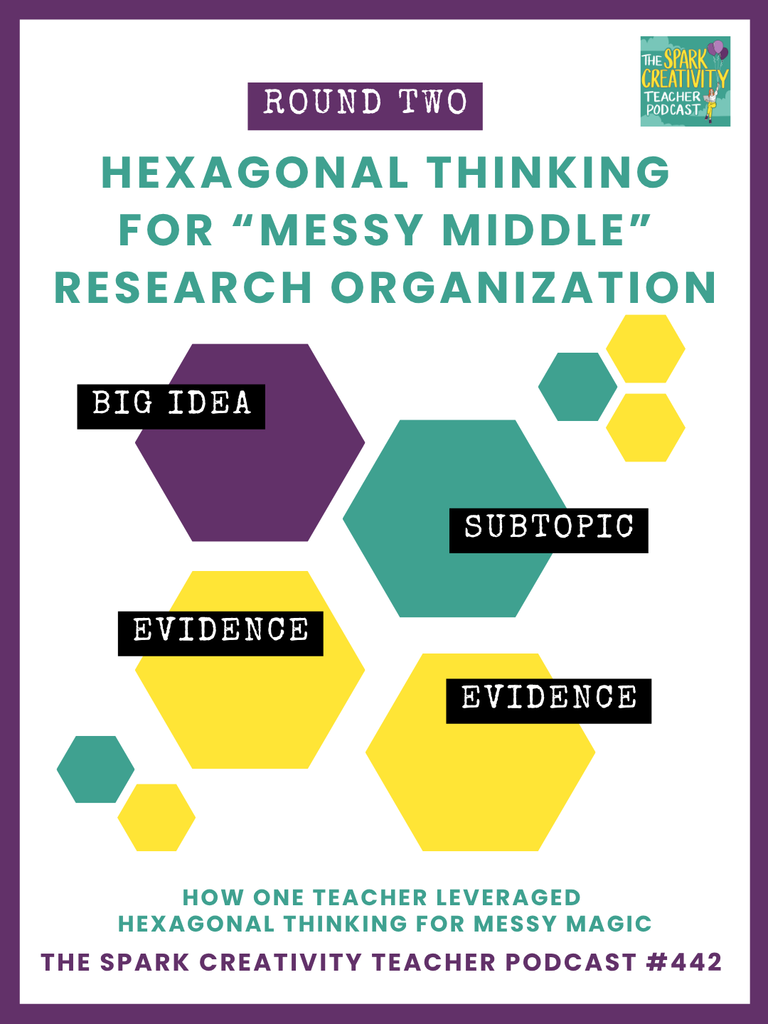
Andi calls her argument unit, “The Art of Nudging Thinking,” striving to teach students to share a compelling perspective and invite people into the conversation, rather than follow one formula for making a point.
For this unit, the second in her hexagonal thinking series with the same group of kids, her students began by picking their own research topic and spending a week and a half researching and exploring those topics.
Then they hit the point where they had tons of notes, all about topics unfamiliar to Andi, and she needed a vehicle to help them get organized.
She decided to try hexagonal thinking. “The key to a successful argument,” she said, “is they have to find their own meaning.”
Each student started with a main topic/idea/question, then pulled from their research and created a hexagon for a subtopic, then one for a piece of information/evidence. They created more and more, beginning to notice how they could tie ideas together, or collapse similar subtopics into one. They could see their ideas spread out in front of them, and that allowed them to organize their research through deep thinking. Andi called it “the messy middle.”
This system worked well. Kids could put their ideas down once, and then manipulate them to make the information work for what they wanted to do. It wasn’t easy, but their classroom is a safe space for making mistakes and learning, and they could always consult with partners. Plus, Andi is always a few steps away to help. “I’m constantly waitressing,” she said. She moved from table to floor to pillow and back again, circulating to help the students move forward, noticing patterns when they’re having issues, helping them move back and try a step in a new way if needed. She is all in as their cheerleader and mentor in this deep, messy thinking.
This time they had done hexagonal thinking before, so they weren’t totally new to the process or the organization. They knew how to keep track of their hexagons, take pictures of their work so they could lay their hexagons out again the next class, etc. They had fewer questions for Andi, because, she said, they knew “this is for me and I’m going to do it my way.”
Andi was really impressed by the quality of their final essays. “Their essays were amazing because they were just so diverse. And it was ALL them.”
Round Three: Hexagonal Thinking for The Civil War in The “Messy Marriage”
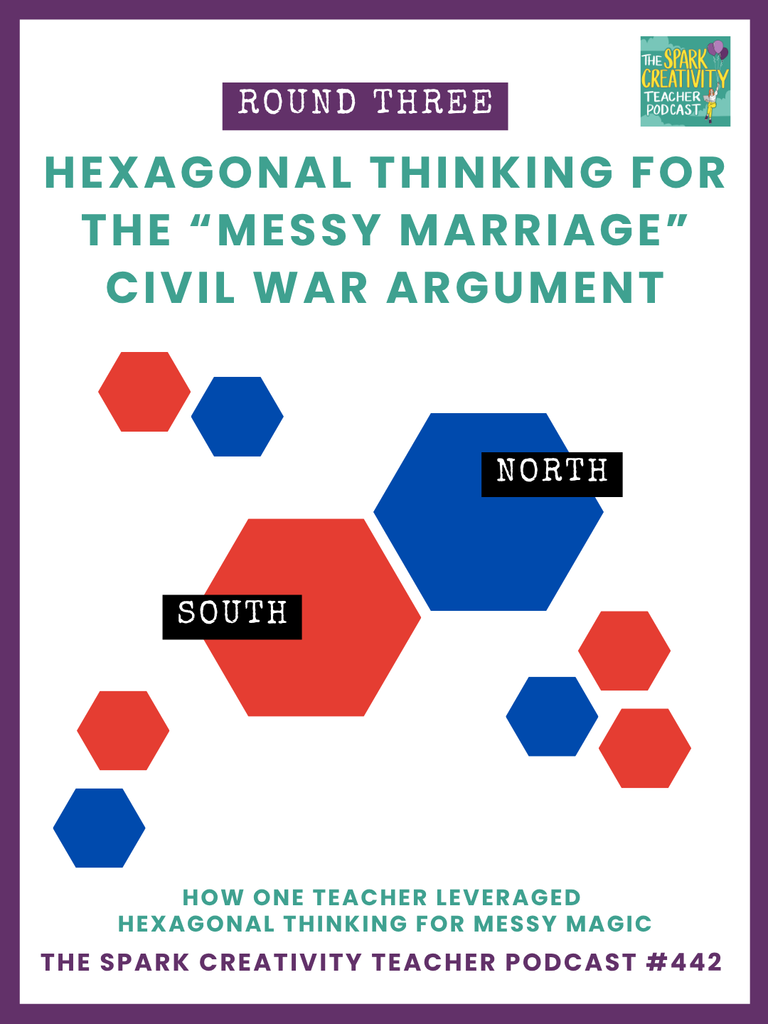
By May, Andi’s 8th graders had rich experience with hexagonal thinking as a method, having used it to organize their ideas for a theme analysis and a research-based argument paper. Both of these tasks had been complex, difficult, “messy,” but also magical. And now it was time for round three!
As the end of the year raced toward them, Andi realized she didn’t have much time for her Civil War Unit, and yet it was a key part of her U.S. History curriculum (she teaches the same kids for ELA and U.S. History). She wanted to get kids thinking deeply quickly, and not get stuck in the textbook.
Her goal in her short but impactful unit was to help kids see how the North and South were interdependent leading up to the Civil War. She wanted them to get the key information, understand the important vocabulary, and most of all, see that the two halves of the country did not exist in isolation.
So she divided the class into partners and started things off with a kind of Jigsaw activity. One partner took the North, one the South. They had a note catcher she made for them with key categories about their region as well as the content vocabulary for the unit pulled from the textbook.
Partners began work. They read their own content sections (south or north only) and began to create hexagons. Partners representing the North made blue hexagons for the key vocabulary words and core ideas from their region, and partners from the South did the same.
Next, they taught each other about their region. And each partner created a “Somebody/Wanted/But/So/Then” statement for their region to turn in so Andi could check their understanding at this point.
Now they were ready for the hexagonal thinking activity Andi called “The Messy Marriage,” a fascinating remix of the strategy to get them thinking about the interdependence of the two regions.
As partners sat together with their hexagons, one began by extending a hexagon of their choice from their region. Their partner’s job was to match it with a related connecting hexagon from their region. For example, if a partner representing the North put out “Factories,” a partner representing the South might put out “Raw Materials.” They spent a period on this activity, making as many connections as possible, and moving from paired hexagons into clusters and larger groups of interconnected concepts without any additional prompting from Andi. They worked under the umbrella of one big question: The North and South are two different worlds, but can they exist without the other?
Next came a new stage Andi called “The Removal Challenge.” She asked them to look at the cluster from the perspective of their region (North or South) and ask themselves, what’s one cluster that if it was removed, would destroy your region? After the partners discussed this from the perspective of one region, they switched and tried it with the other. They were trying to figure out, would it have been possible for one side to be independent of the other side?
The activity went really well. Kids were able to dive into deep thinking. Andi’s California framework for U.S. History focuses on cause and effect, discussing implications of events, and looking for pattterns, and she find that hexagonal thinking makes it easier and more fun to get into these things. “It was pretty amazing,” she reflected.
In the end, kids wrote 300-500 words on the question, “Why fight this war?” They took the perspective of a historical figure from the North or South, and drew on all the “messy” magic of their deep collaborative thinking.
Takeaway Tips: Andi’s Advice for Teachers Remixing Hexagonal Thinking
First off, give yourself permission to have it not go great on the first try. If things don’t go as planned, be honest with the students and try again. Reframe the activity with what you learn from the first attempt. You’re modeling reflection and resiliency for your students.
Next, have fun! Set up your guardrails, have scaffolds ready, but then get out of the way and let students experience productive struggle. Stay close to help make sure they’re not getting overwhelmed. They need you during this process of making meaning.
Finally, don’t fear messy thinking! Work for an environment that shows you welcome struggle and mess in deep thinking. Students need to know they can make mistakes and get through them. Hexagonal thinking doesn’t fit well in an environment where the right answer reigns supreme. It’s about the process and the growth that comes with it.
Want to Contact Andi?
She welcomes conversations about this! You can reach out to her by email to teach0103@gmail.com.